






When the Reserve Bank of New Zealand (RBNZ) adjusts the Official Cash Rate (OCR), the ripple effects are felt from Cape Reinga to Bluff. However, these ripples are not uniform waves; they behave more like unpredictable currents, surging powerfully in some areas while barely disturbing the surface in others. A 50-basis-point hike can trigger a sharp correction in Auckland's suburban property market, yet cause only a mild recalibration in the commercial orchard valuations of Hawke's Bay. This regional disparity in sensitivity to interest rate changes is not random noise; it is the direct output of a complex algorithm of local economic drivers, sectoral composition, and household financial resilience. For analysts, policymakers, and investors, understanding this geographic calculus is crucial for accurate forecasting and risk management.
The Core Drivers of Regional Interest Rate Sensitivity
At its heart, a region's sensitivity to monetary policy is a function of its exposure to interest-rate-sensitive sectors and the leverage of its economic participants. We can model this sensitivity by examining three primary, interconnected variables: the composition of regional GDP, household debt-to-income ratios, and the structure of the local housing market.
1. Economic Base and Sectoral Composition
Regions heavily reliant on interest-rate-sensitive industries—primarily construction, real estate services, and durable consumer goods retail—act as amplifiers for OCR movements. Conversely, regions with a high concentration in primary production (dairy, horticulture, forestry) or insulated public-sector employment demonstrate more muted reactions. The export income from primary sectors, often priced in foreign currency, can provide a buffer, though high levels of on-farm debt can offset this.
Data Insight: According to Stats NZ's Regional Gross Domestic Product: Year ended March 2023, the construction sector's contribution to regional GDP varies dramatically. In fast-growing regions like Waikato and Bay of Plenty, construction comprises over 7% of GDP, significantly above the national average of 6.5%. In contrast, in the more diversified Wellington region, it sits at just 5.2%. When borrowing costs rise, regions with an above-average construction GDP share typically experience sharper slowdowns in consent issuance and related employment.
2. Household Indebtedness and Mortgage Stress Vulnerability
The transmission mechanism of interest rates works most directly through the household balance sheet. Regions with higher median house prices relative to incomes, and consequently larger mortgage debts, are inherently more vulnerable. The critical metric here is the estimated debt-servicing cost as a percentage of disposable income.
Drawing on my experience supporting Kiwi companies in financial analytics, I've observed that micro-level data often reveals starker realities than national averages. A suburb with a high proportion of recent, highly leveraged first-home buyers will exhibit immediate distress signals—reduced discretionary spending, increased mortgage arrears—long before a region dominated by outright homeowners or long-term, fixed-rate mortgages.
3. Housing Market Dynamics: Investor Activity and Price Cycles
Investor behavior is a key volatility multiplier. Regions with a high percentage of residential properties owned by investors are more sensitive to rate changes for two reasons: investor demand is more elastic and driven by yield calculations, and many investors are more highly leveraged. An RBNZ data series shows that in areas like South Auckland and parts of Christchurch, investor share of purchases exceeded 40% at the market peak. When interest rates rise and loan-to-value ratio (LVR) restrictions bite, investor demand can evaporate rapidly, accelerating price declines.
Case Study: A Tale of Two Regions – Auckland vs. Southland
To illustrate these drivers in action, let's conduct a comparative analysis of New Zealand's most and least sensitive regions, based on current economic structures.
Problem: Both Auckland and Southland faced the identical monetary policy tightening cycle that began in late 2021, with the OCR rising from 0.25% to 5.5%. The economic impact, however, was geographically asymmetric.
Analysis & Action (The Regional Profile):
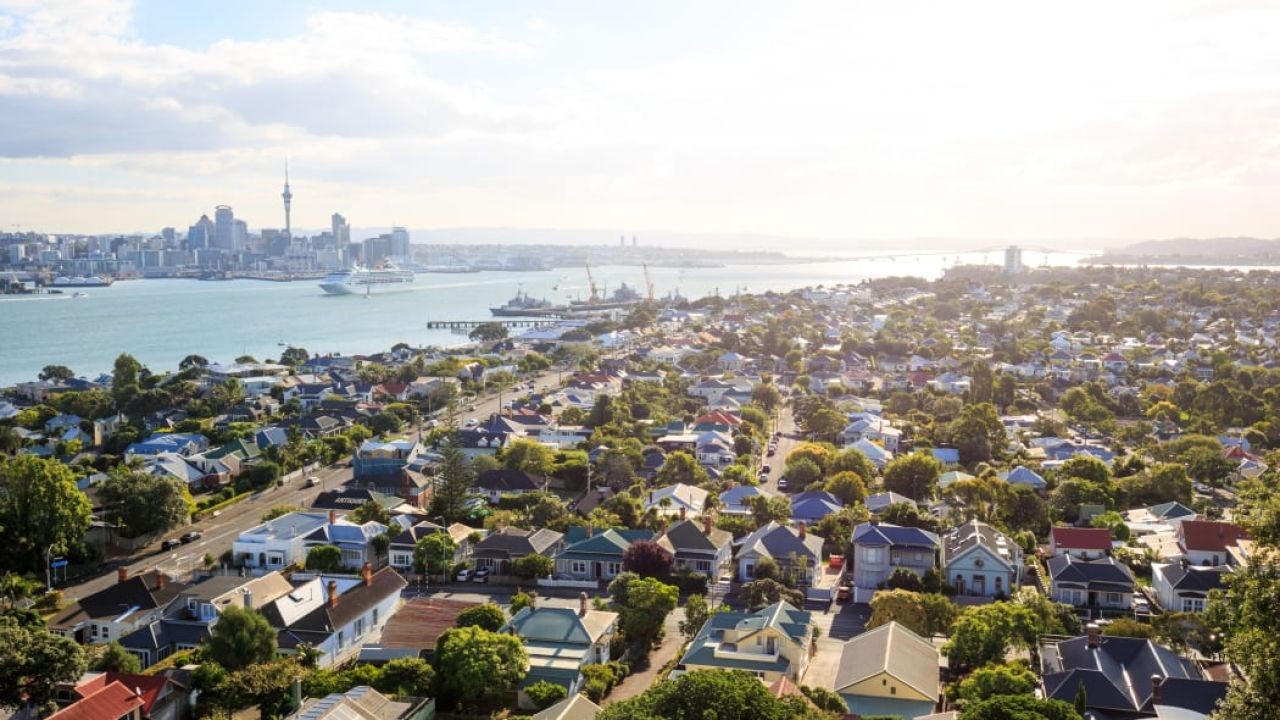
- Auckland: Characterized by a high-cost housing market (median price over $1 million at the peak), a significant construction sector, and a substantial share of investor-owned properties. Household debt-to-income ratios are among the nation's highest. Its economy, while diversified, is heavily weighted towards services, finance, and construction—all rate-sensitive.
- Southland: Features a lower-cost housing market (median price typically ~$400,000), an economic base dominated by dairy farming and allied processing industries, and a higher rate of home ownership with lower relative debt. Export dairy prices, influenced by global commodity markets, play a larger role in local income than OCR settings.
Result: The outcomes diverged sharply.
- Property Market: CoreLogic data indicates Auckland's property values fell approximately 17% from peak to trough during the tightening cycle, while Southland's values declined by a more modest 10%. The velocity of the decline was also faster in Auckland.
- Business Confidence & Consumption: ANZ's Regional Business Outlook has consistently shown deeper pessimism in Auckland regarding investment and profit expectations during high-rate periods, linked to weaker consumer spending. Southland's outlook, while negative, has been tempered by strong dairy payouts.
- Mortgage Stress: While arrears data is nuanced, the proportion of homeowners refixing mortgages at rates above 6% is vastly higher in high-price regions like Auckland, directly squeezing disposable income.
Takeaway: This comparison underscores that sensitivity is not about regional "strength" or "weakness," but about structural exposure. Southland's insulation stems from its export-driven primary sector and affordable housing, not necessarily superior economic performance. Auckland's sensitivity is a product of its financialized housing market and consumption-led growth model.
Expert Opinion: The Hidden Amplifier – The "Wealth Effect" Channel
Beyond direct debt-servicing costs, a critical and often under-modeled channel is the regional wealth effect. In my experience consulting with local businesses in New Zealand, I've seen this play out repeatedly in consumer-facing sectors. Homeowners in regions that experienced meteoric price rises (e.g., 40%+ gains in parts of Wellington and Auckland during the COVID boom) became accustomed to seeing their paper wealth increase monthly. This fueled confidence and discretionary spending on renovations, vehicles, and luxury goods.
When interest rates rise and prices fall, the effect reverses sharply. The perception of being poorer, even if the mortgage payment is unchanged due to a fixed term, causes immediate psychological contraction in spending. Regions that saw the largest price gains therefore experience a double hit: the direct cost-of-debt increase and a potent negative wealth effect. This helps explain why otherwise affluent regions can show pronounced economic sensitivity.
Pros and Cons of Regional Interest Rate Sensitivity
Understanding this disparity is not merely academic; it has real-world implications for economic stability, policy, and investment.
✅ Potential Advantages (Pros)
- Automatic Stabilizer for the Nation: Highly sensitive regions like Auckland act as a shock absorber for the entire economy. Their rapid slowdown in demand helps curb nationwide inflation faster, potentially shortening the required period of high OCR.
- Clear Signaling for Policy: The pronounced reaction in sensitive regions provides the RBNZ with clear, early feedback on the effectiveness of its monetary policy, allowing for more calibrated future decisions.
- Investment Opportunity Identification: For analysts, mapping sensitivity creates a framework for identifying regions that may be oversold during tightening cycles or overheated during easing cycles, revealing relative value opportunities.
❌ Significant Risks and Drawbacks (Cons)
- Amplified Boom-Bust Cycles: High sensitivity exacerbates regional economic volatility. A boom fueled by low rates leads to over-investment and asset bubbles, which then deflate painfully during tightening, causing disproportionate job losses and business failures in those areas.
- Inequitable Distribution of Pain: Monetary policy becomes a blunt geographic instrument. Homeowners and businesses in sensitive regions bear the brunt of the anti-inflation fight, while those in insulated regions experience less direct pressure, potentially leading to socio-economic and inter-regional tensions.
- Complicates Fiscal and Social Policy: The central government faces greater demands for targeted support (e.g., for struggling homeowners or businesses) from the most affected regions, complicating national budget planning and creating perceptions of unfairness.
- Risk of Over-Correction: If the RBNZ sets policy based on national aggregates that are skewed by extreme reactions in sensitive regions, it risks over-tightening and causing a deeper recession than necessary for the country as a whole.
Common Myths and Costly Analytical Mistakes
Several persistent misconceptions can lead to flawed analysis and poor decision-making.
Myth 1: "A strong regional economy guarantees low interest rate sensitivity." Reality: Strength can be a vulnerability. Auckland's economically "strong" status is precisely why it's sensitive—its strength is built on growth sectors like construction and finance that thrive on cheap credit. A region like the West Coast, with a less dynamic economy but lower debt, may be more resilient to rate hikes.
Myth 2: "Sensitivity is solely about house prices." Reality: While housing is the primary channel, sectoral composition is equally vital. Taranaki, despite having relatively affordable housing, can be sensitive due to its high proportion of SMEs in service and trade sectors that rely on consumer and business investment spending, which contracts with higher rates.
Myth 3: "Once a region is deemed sensitive, it remains so forever." Reality: Sensitivity is dynamic. If a period of high rates leads to significant deleveraging (e.g., households paying down debt), a region's sensitivity can decrease over time. Conversely, a surge in new lending during a boom can increase future sensitivity.
Costly Mistake: Relying on Averages. The biggest analytical error is using national or broad regional data alone. Based on my work with NZ SMEs, I've seen that a business in a specific suburb of Hamilton faces a completely different consumer environment than one in the CBD or a rural town within the same Waikato region. Granular, sub-regional data on sales, debt, and employment is essential for accurate assessment.
Future Trends and Predictions for New Zealand
The landscape of regional sensitivity is evolving. Several trends will reshape it over the next five years:
- The "Fixed-Rate Cliff" Reshuffling: The large cohort of homeowners who fixed at ultra-low rates during 2020-2021 are now refixing at much higher rates. This process will roll through different regions at different times, creating localized waves of disposable income contraction rather than a single national event. Regions with a higher concentration of mortgages fixed in late 2020 will feel this pinch later.
- Climate Change and Insurance Costs: Increasingly, sensitivity will be driven not just by the OCR but by soaring insurance premiums in climate-vulnerable areas (e.g., flood-prone parts of Nelson-Tasman, coastal properties). This acts as a de facto regional interest rate hike, compounding the RBNZ's effects in specific locales.
- Policy-Driven Reshaping: The potential reintroduction of debt-to-income (DTI) ratios by the RBNZ would have a geographically disparate impact, disproportionately cooling markets in high-price, high-debt regions. Similarly, any central or local government policies aimed at diversifying regional economies (e.g., MBIE's Regional Strategic Partnerships) could, over the long term, reduce sensitivity.
A bold, data-backed prediction: By 2028, we will see the emergence of a new sensitivity hotspot—regions that have experienced significant internal migration and growth during the post-COVID period (e.g., parts of Marlborough and Central Otago). The associated housing inflation and new debt taken on by migrants will make these growing areas newly vulnerable to the next interest rate cycle.
Actionable Insights for Analysts and Decision-Makers
How can professionals apply this framework today?
- Build a Regional Sensitivity Dashboard: Create a composite index for key regions using indicators: Construction GDP share, median mortgage debt to income, investor purchase share, and household discretionary income estimates. Update quarterly with Stats NZ, REINZ, and RBNZ data.
- Stress Test for Geography: When modeling business or investment performance, run scenarios with differentiated regional impacts. Don't assume a uniform 10% sales drop nationwide; model a 15% drop in high-sensitivity regions and a 5% drop in low-sensitivity ones.
- Monitor Leading Indicators at a Micro Level: Watch for early warning signs like declines in local consent issuance, increases in listings inventory on real estate portals for specific towns, and regional bank lending data. These often lead broader economic turns.
People Also Ask (FAQ)
How do interest rate changes specifically impact different industries across NZ regions? Rate hikes hit construction and real estate services hardest in growth regions like Bay of Plenty. In contrast, export-focused regions like Southland see more impact from exchange rate movements (a byproduct of OCR changes) on their dairy or timber returns, which can offset domestic borrowing costs.
What can local councils in sensitive regions do to mitigate economic volatility? Councils can foster economic diversification by supporting sectors less tied to credit cycles, such as technology, education exports, or value-added food processing. Prudent long-term infrastructure planning that avoids stoking property bubbles during booms is also crucial.
Is there a case for regionally differentiated monetary policy in New Zealand? While theoretically insightful, practical implementation is highly challenging for a small, integrated economy like New Zealand's. Differentiated policy could create arbitrage and complicate financial system management. The RBNZ's mandate is national price stability, making geographically targeted OCR unlikely.
Final Takeaway
Interest rate sensitivity in New Zealand is a deeply geographic phenomenon, a story told not in national headlines but in local data sets. For the analyst, the key is to move beyond the aggregate and dissect the underlying structural drivers—the sectoral mix, the debt load, the housing market mechanics—that determine how a monetary policy shock will propagate through each region's unique economic fabric. The next OCR move will not be one story, but twenty. Understanding which regions will write the most dramatic chapters is the essence of insightful economic and investment analysis in Aotearoa.
Ready to deepen your analysis? Begin by downloading the latest Stats NZ subnational GDP accounts and CoreLogic regional sales data. Cross-reference these with RBNZ household financial data to build your first regional sensitivity scorecard. The patterns you uncover will provide a decisive edge.
Related Search Queries
- New Zealand regional economy interest rate vulnerability
- Auckland vs. provincial NZ interest rate impact
- OCR impact on NZ housing markets by region
- Which NZ regions are most recession-proof?
- Household debt South Island North Island comparison
- RBNZ monetary policy regional effects study
- New Zealand economic sensitivity index by region
- How does dairy price affect interest rate sensitivity?
For the full context and strategies on Why Some Regions in NZ Are More Sensitive to Interest Rate Changes, see our main guide: Vidude Vs Threenow New Zealand.