




For many, the world of motorsport exists as a distant spectacle, a televised ballet of noise and colour populated by international superstars and corporate titans. The perception is one of an exclusive, prohibitively expensive club, its gates firmly shut to the average enthusiast. This is a profound misconception, particularly in New Zealand. Beneath the global glare of Formula 1 and the iconic Bathurst 1000 lies a thriving, accessible, and deeply ingrained grassroots motorsport culture. It is a subculture that functions as a vital proving ground, a community hub, and a significant, though often overlooked, component of New Zealand's engineering and sporting identity. The pathway from spectator to competitor is not only possible but is structured, supported, and woven into the fabric of local communities from Invercargill to Kaitaia.
The Cultural and Economic Engine Room: Grassroots Motorsport in NZ
To understand how to participate, one must first appreciate the ecosystem that makes it viable. New Zealand punches far above its weight in global motorsport, a fact attributable not to a single superstar, but to a robust and self-sustaining domestic scene. This is the engine room that has produced world champions like Scott Dixon, Shane van Gisbergen, and Earl Bamber. The system operates on a club-based model, with organisations like Motorsport New Zealand (MSNZ) sanctioning events at over 80 dedicated venues and closed public road circuits nationwide. From my observations across Kiwi businesses, the economic activity generated is substantial but diffuse. It encompasses regional tourism (events like the Highlands Motorsport Park festivals), specialist engineering and fabrication workshops, parts importers, and a vast network of volunteerism. A 2022 report commissioned by MSNZ highlighted that motorsport contributes over $300 million annually to the national economy and supports the equivalent of over 2,500 full-time jobs. This is not merely a hobbyist pastime; it is a legitimate industry with a tangible GDP footprint.
The Participant's Dilemma: Passion vs. Pragmatism
The aspiring competitor immediately faces a fundamental choice, dictated by both ambition and resource. This is not a simple linear progression but a forked path, each with distinct cultures, costs, and entry points.
The Circuit Racing Pathway: Structured, Technical, and Capital Intensive
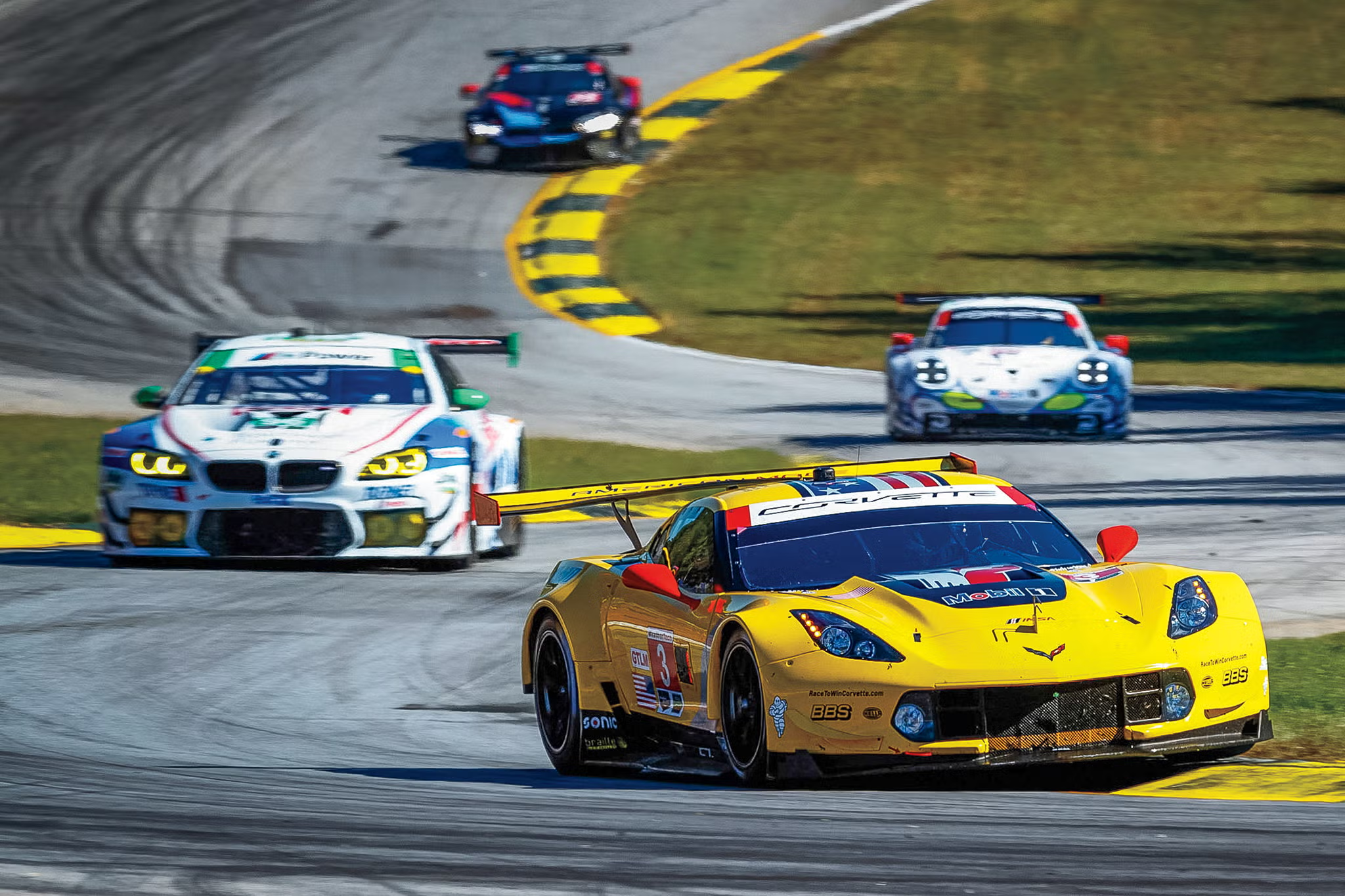
This is the classic image of motorsport: wheel-to-wheel racing on purpose-built tracks like Hampton Downs, Taupō International Motorsport Park, or Ruapuna. Participation is rigorously structured through a licence grading system (from Clubman to National) and requires compliance with stringent safety standards. The vehicles range from production-based categories (like Mazda Pro7 or Honda Cup) to purebred single-seaters (Formula First, Toyota 86). The costs are significant. Based on my work with NZ SMEs in the automotive performance sector, a competitive season in a production class can range from $20,000 to $60,000, encompassing entry fees, consumables (tyres, brakes, fuel), transport, and inevitable repairs. The barrier is not just financial but technical, requiring a mindset geared towards continuous vehicle development and data analysis.
The Grassroots & Rally Pathway: Accessible, Rugged, and Community-Focused
In contrast, the grassroots scene offers a markedly different, and often more accessible, ethos. This includes autocross (grass or sealed surface), hillclimbs, and rallying. Here, the vehicle can often be a lightly modified road car, with a roll cage and safety gear being the primary investments. The culture is less about outright spending and more about ingenuity, car control, and community. Rallying, in particular, holds a sacred place in New Zealand's motorsport heartland. Events like the Rally of Otago or the Coromandel Rally utilise the country's vast network of closed forestry and backcountry roads. Drawing on my experience in the NZ market, the rally community operates on a co-operative model; competitors often share service crews and expertise, lowering the barrier to entry. The skill set shifts from aerodynamic efficiency to mastering unpredictable surfaces and pacenote precision.
Debunking the Myths: The Realities of Kiwi Motorsport
Several pervasive myths deter potential participants. Let's dismantle them with local context.
Myth 1: "You need a fortune and a factory-backed team to compete." Reality: While top-tier categories are expensive, the backbone of NZ motorsport is the amateur competitor. Countless categories are designed for affordability. The iconic Formula First class, for instance, provides spec racing with controlled costs, where a competitive turnkey car can be found for under $15,000. The entire ecosystem thrives on the individual or family-run effort.
Myth 2: "It's only for expert drivers and mechanics." Reality: Motorsport New Zealand's licensing system is designed as a progressive education. Every champion started with a Clubman licence, obtainable after completing a certified driver training course. These courses, run at local tracks, teach vital safety and car control skills. Furthermore, most clubs run regular "come and try" days and novice championships, creating a supportive environment for learning.
Myth 3: "Motorsport is environmentally irresponsible and has no future." Reality: This is the most critical industry debate. The sector is acutely aware of its environmental footprint and is innovating in response. MSNZ has introduced an "E Motorsport" championship for electric vehicles. Moreover, the development of sustainable synthetic fuels, which Porsche and others are heavily investing in globally, offers a pathway to carbon-neutral combustion engine racing. In New Zealand, with our high renewable energy mix, the potential for producing such fuels and powering electric race vehicles presents a unique strategic opportunity. The industry's future hinges on its ability to be a testbed for sustainable automotive technology.
A Step-by-Step Guide to Your First Season
Transforming interest into action requires a methodical approach. Here is a practical, NZ-focused roadmap.
Phase 1: Foundation & Education (Months 1-3)
- Get Your Licence: Enrol in an MSNZ-accredited driver training course. This is non-negotiable and provides the essential safety certificate and licence application pathway.
- Choose Your Discipline: Attend events as a spectator. Visit a local club race, a rally, and an autocross. The culture and costs are visibly different. Speak to competitors in the paddock; you will find most are exceptionally welcoming to newcomers.
- Join a Club: Become a member of your local motorsport club (e.g., Auckland Car Club, Wellington Motorcycle & Car Club). Membership provides insurance, event access, and a wealth of mentorship.
- Key action for young Kiwis: Investigate the "MSNZ Scholarship" program, which aims to identify and support emerging talent across various disciplines.
Phase 2: Acquisition & Preparation (Months 3-6)
- Source a Vehicle: Buy, don't build, for your first car. The market for ready-to-race vehicles in NZ is active on platforms like TradeMe Motors and through club forums. Look for a popular, well-supported class where spare parts and setup knowledge are readily available. A pre-built car in a popular category is always cheaper and less frustrating than a project.
- Safety Compliance: Ensure the vehicle has a current Motorsport Logbook (its safety passport) and that all safety gear (helmet, suit, HANS device) is within its certification date. Never compromise here.
- Build Your Support Network: You are not a one-person team. Recruit a couple of friends or family members to help with logistics, spannering, and morale. Having worked with multiple NZ startups, the principle is identical: a small, dedicated team outperforms a lone genius.
Phase 3: Execution & Progression (Ongoing)
- Start Small: Your first goal is not to win, but to finish. Enter a local club day or a novice championship. Focus on consistency and learning the car's behaviour.
- Embrace the Data: Even basic lap timing and video analysis are invaluable. Compare your lines and braking points with more experienced drivers.
- Develop a Realistic Budget: Track every cost. From my consulting with local businesses in New Zealand, the businesses that survive are those that manage cash flow meticulously. Your racing campaign is no different. Factor in a 20-30% contingency for unexpected repairs.
- Seek Sponsorship, But Be Realistic: Local businesses may support you for branding exposure, but their contribution is often in-kind (parts, services) rather than cash. Present a professional proposal outlining what tangible marketing value you can offer them.
The Hidden Economics and Future Trajectory
The financial model of grassroots motorsport is a fascinating micro-economy. It is largely circular, with money flowing between competitors, specialist workshops, and event organisers. However, a significant hidden challenge is the rising cost of compliance and insurance, pressures felt across all recreational sectors in New Zealand. Furthermore, the demographic of competitors is aging. The future health of the sport depends on lowering the barriers for the next generation. This is where digital sim-racing presents a profound opportunity. What was once dismissed as a game is now a legitimate training tool and a potential feeder series. Global examples like the F1 Esports Series show how virtual talent can transition to real cars. In New Zealand, establishing formal bridges between sim-racing communities and physical clubs could democratise talent discovery and initial training at a fraction of the cost.
The other seismic shift is the technological transition. New Zealand is uniquely positioned to become a leader in sustainable motorsport. Our abundant renewable energy and innovative agri-tech sector could facilitate the production of bio-fuels. Our compact geography and existing circuit infrastructure make it feasible to pioneer national EV racing series with manageable charging logistics. The organisations and sponsors that invest in this transition now will secure the social licence and commercial relevance of the sport for decades to come.
Final Takeaway: Your Place on the Grid Awaits
Participating in car racing in New Zealand is not a fantasy reserved for the wealthy elite. It is a tangible, structured, and deeply rewarding pursuit embedded in our national culture. The pathway is clear: educate yourself through the official licensing system, immerse yourself in the community by joining a club, and make a pragmatic vehicle choice for your chosen discipline. The true value lies not solely in the competition, but in the skills forged—mechanical aptitude, financial planning, strategic thinking, and the profound focus required at speed. It is a demanding teacher, but one that offers unparalleled lessons in personal accountability and perseverance.
The call to action is straightforward. This weekend, do not just watch motorsport—go and experience it. Find your local club event, walk through the paddock, and ask questions. You will discover that the grid is not a closed fortress, but a community of passionate individuals who started exactly where you are now. The question is not if you can participate, but when you will choose to begin.
People Also Ask (FAQ)
What is the absolute cheapest way to start racing in NZ? Autocross or grass karting. These disciplines allow you to use a minimally modified road car or a low-cost kart, focusing purely on driver skill with minimal running costs, often for less than $200 per event.
How does motorsport in NZ contribute to the automotive industry? It acts as a vital R&D and talent pipeline. Engineering solutions developed for racing often trickle down to performance road cars, and the sector trains highly skilled technicians, fabricators, and data engineers who feed into the wider automotive and engineering industries.
Is there a future for petrol-powered racing in New Zealand? Yes, but it will evolve. The future lies in carbon-neutral synthetic fuels, which allow existing combustion engines to run with a net-zero carbon footprint. This technology preserves historical vehicles and existing infrastructure while meeting environmental goals.
Related Search Queries
- Motorsport New Zealand licence cost
- Cheapest race car classes NZ 2024
- How to become a rally co-driver NZ
- NZ racetrack open days public
- Formula First racing budget
- EV racing series New Zealand
- Motorsport club membership benefits
- Buying a used race car TradeMe
- MSNZ accredited training courses
- Hillclimb events North Island calendar
For the full context and strategies on How to Participate in Car Racing in New Zealand – A No-Nonsense Guide for New Zealanders, see our main guide: Product Demo Tutorial Videos Nz.