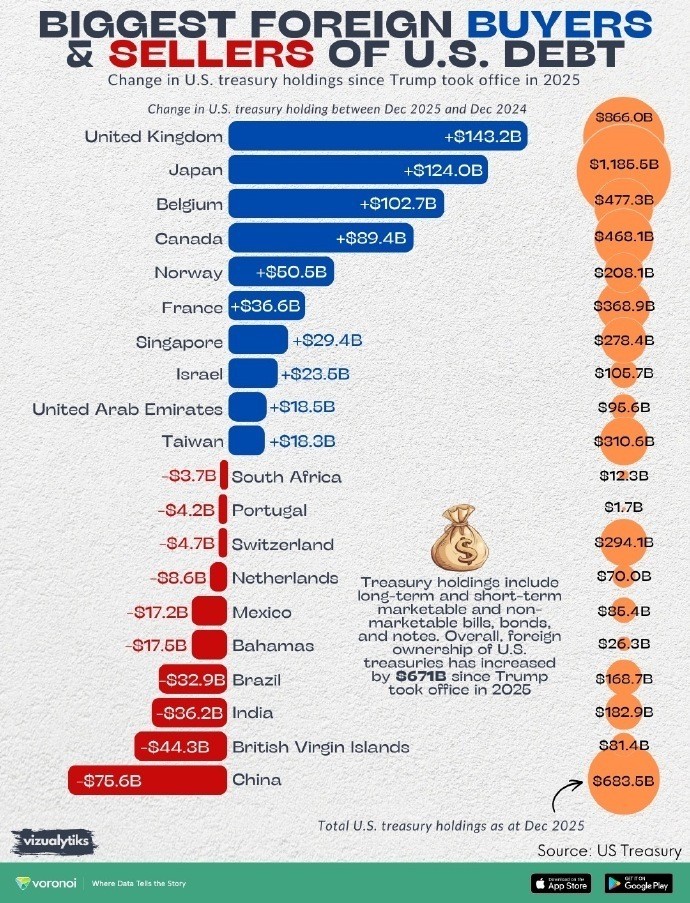
While it's important to identify foreign buyers and sellers of US debt, focusing solely on these transactions may overlook the broader economic implications and interdependencies that shape our financial landscape.
Hey! Just read about the biggest foreign buyers and sellers of US debt. It’s wild how much influence countries like China and Japan have on our economy. I mean, it feels like they’re holding a giant leash on our financial stability.

Also, did you see how some European countries are starting to back off from buying? It makes you wonder if they’re losing faith in the dollar. I guess the whole thing is a balancing act.
And then there’s the Fed’s response to all of this. It’s like a game of chess, right? They have to play their pieces carefully to avoid a total meltdown. Anyway, just some food for thought over a cup of coffee later!
While countries like China and Japan are often highlighted as the largest foreign holders of U.S. debt, it’s worth noting that smaller nations, such as Luxembourg and the Cayman Islands, can also play significant roles due to their status as financial hubs, where many institutional investors are based. This can skew the perception of where U.S. debt is really held, as these locations may not represent the actual economic power behind the investments.
Additionally, the recent trend of increasing U.S. debt ownership by private investors and corporations signifies a shift in the landscape, suggesting that the narrative around foreign buyers might be oversimplified. As domestic entities begin to acquire a larger portion of U.S. debt, it raises questions about the long-term implications for foreign investment and economic influence.
Moreover, the motivations of foreign buyers can vary significantly; for instance, while some countries may invest in U.S. debt as a means of currency stabilization, others might do so purely for speculative reasons, complicating the general understanding of foreign investment strategies in U.S. securities. This nuanced view highlights the complexity of the debt market and the diverse interests at play.
It's interesting to see how foreign countries play such a big role in holding US debt. China and Japan have been the biggest buyers for a while now, which shows how intertwined our economies are. I guess it makes sense for them to invest in a stable asset like US Treasuries, but it does raise questions about how reliant we are on these relationships.
On the flip side, it's also notable that some countries have been selling off their US debt. Countries like Russia have cut back on their holdings, which could reflect shifting geopolitical dynamics. It’s a reminder that financial markets aren’t just about numbers; they’re deeply connected to global politics.
I wonder how sustainable this reliance on foreign buyers really is. If these countries decided to pull back significantly, it could have a major impact on interest rates and the overall economy. It’s a delicate balance, and I think a lot of people don’t realize how much it can affect everyday life, like mortgage rates and loan availability.
Overall, it’s a fascinating topic that highlights the complexities of international finance. It makes me appreciate how interconnected our world is, even when we’re just enjoying a cup of coffee.
It's fascinating to see how the world plays a role in our economy. The dynamics of foreign buyers and sellers of US debt tell a story of trust and strategy. It’s a reminder that even from the outback, we’re connected to a global stage.
In considering the dynamics of foreign buyers and sellers of U.S. debt, how might the motivations of these countries be influenced by their own economic interests, particularly in relation to geopolitical tensions or trade relations with the United States? This perspective could shed light on whether their involvement in U.S. debt is purely financial or also strategically motivated.
6 Comments
lakeishacowell
2 days agoBritish Landscaping Servi
2 days agoVapor Station Smoke Shop
2 days agoJames Morgan
3 days agoManohar International Airport
3 days agoDedraPeake
3 days ago