




The debate over self-checkout machines in Australian retail is often framed as a simple trade-off between operational efficiency and customer service. This is a superficial analysis. As an export and trade specialist, I view this through a different lens: one of strategic competitiveness, labour market dynamics, and the integrity of our domestic supply chain. The question is not merely about convenience, but about whether this automation trend is strengthening or weakening the foundational resilience of Australian retail—a critical sector that interfaces with every consumer and supports thousands of domestic suppliers. The data suggests we are at an inflection point, and the path we choose will have profound implications for our trade-exposed economy.
The Efficiency Mirage: Unpacking the True Cost of Automation
Proponents of self-checkout (SCO) systems tout labour cost savings and throughput speed. However, this narrative collapses under scrutiny when one examines total operational costs. The initial capital expenditure for hardware and software integration is substantial. More critically, the ongoing costs of loss prevention, machine maintenance, and customer assistance often negate the purported labour savings. A 2023 study by the University of Queensland, in partnership with retail analysts, found that shrink (loss from theft, error, and damage) is significantly higher at SCO lanes compared to staffed checkouts. This is not a minor accounting line; it directly erodes gross margin.
For Australian businesses, this has a multiplier effect. Reduced margins pressure buyers to squeeze domestic suppliers on price, undermining the sustainability of local manufacturing and agriculture—key sectors our trade policies aim to protect. When a major supermarket's margin is compromised by preventable loss, their procurement teams inevitably seek cost concessions from Australian growers and producers, exporting the financial pain upstream in the supply chain. This creates a perverse scenario where a technology designed to improve efficiency actively weakens the economic ecosystem it operates within.
Case Study: Woolworths Group – A Cautionary Tale on Scale and Shrink
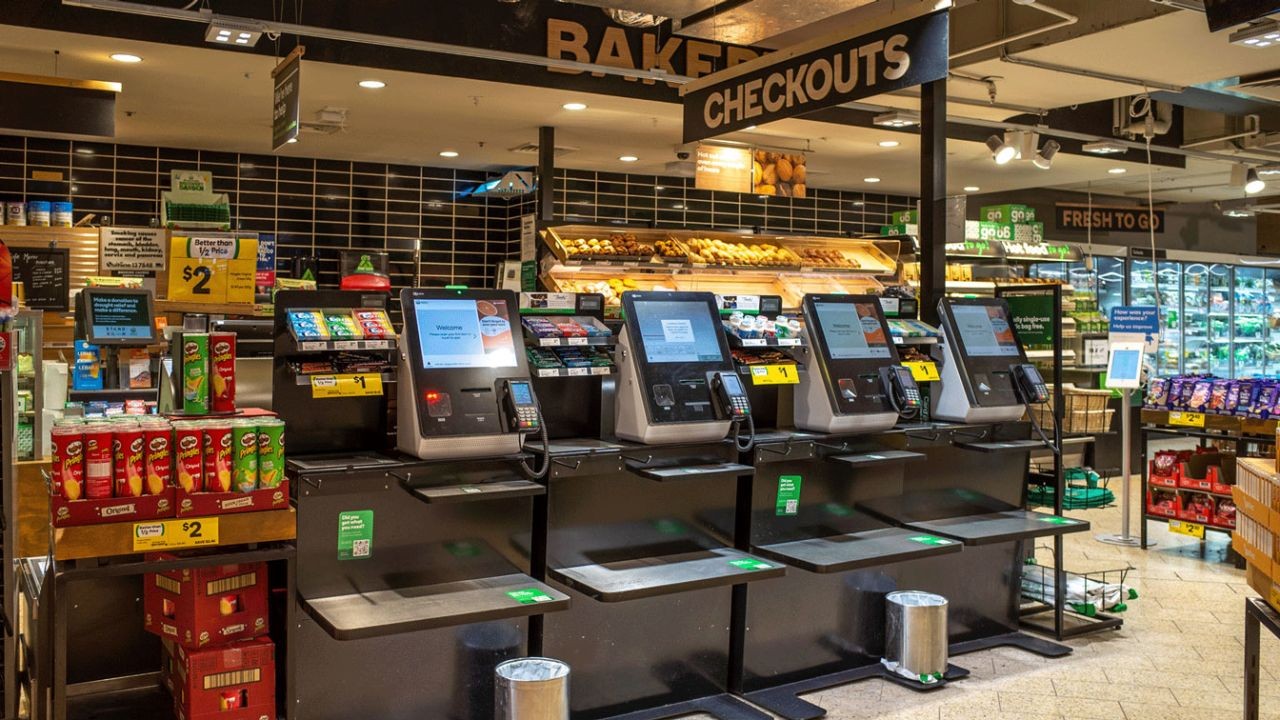
Problem: Woolworths, a dominant force in the Australian Retail sector, aggressively rolled out self-checkout systems across its network to reduce wage costs and modernise the customer experience. However, by 2022, internal audits and industry reports began indicating a sharp, correlated increase in inventory shrinkage. The problem was twofold: opportunistic theft ("scan avoidance") and innocent errors by customers unfamiliar with the technology. This was not just a loss of product; it represented a direct leak in revenue and a distortion of demand data sent back to Australian suppliers.
Action: The company was forced to invest heavily in countermeasures. This included deploying more staff as "SCO hosts" to monitor lanes, integrating weight-sensor surveillance technology, and implementing real-time receipt checks at exits. These actions essentially re-introduced labour and complexity that the SCOs were meant to eliminate. Furthermore, Woolworths had to engage with the Australian Competition and Consumer Commission (ACCC) regarding concerns over its checkout processes and customer fairness.
Result: The financial equation shifted. While some wage costs were saved, they were offset by:
- Increased capital and operational expenditure on security tech.
- Higher costs associated with loss prevention personnel.
- Reputational damage and customer frustration, potentially impacting long-term loyalty.
- A strained relationship with suppliers due to unpredictable demand signals caused by inventory inaccuracies.
Takeaway: This case demonstrates that the ROI on self-checkout is far more nuanced than a simple labour-cost calculation. For Australian retailers, the true cost includes systemic risk to inventory integrity and supplier relationships. The Woolworths experience shows that scaling a flawed efficiency model can lead to a net-negative outcome, forcing a reactive and costly strategy that undermines the initial business case.
The Human Capital Erosion: A Trade Specialist's Labour Market Analysis
From a trade and economic perspective, a nation's competitiveness is rooted in the skills and employment stability of its workforce. The retail sector is a massive employer in Australia, often serving as an entry point to the labour market for young people, migrants, and students. According to the Australian Bureau of Statistics (ABS), the Retail Trade sector employed over 1.3 million people as of late 2023, representing a critical component of domestic consumption and economic health.
The systematic de-skilling of the checkout role—shifting from a trained operator managing transactions, customer service, and loss prevention to a mere host troubleshooting machines—has long-term implications. It reduces the pathway for skill development and career progression within the sector. Furthermore, it contributes to labour casualisation, a trend the RBA and Treasury have noted can suppress wage growth and consumer spending power. A weaker domestic consumer, with less secure employment and income, is less capable of absorbing the output of Australian exporters who also rely on the home market. We are inadvertently undermining our own domestic demand base.
The Critical Debate: Productivity vs. Social Capital
This issue presents a stark dichotomy between two competing visions for Australian retail.
✅ The Advocate Perspective: Inevitable Technological Progress
Proponents argue that automation is an unstoppable global trend essential for maintaining competitiveness. They point to:
- Consumer Demand: A segment of shoppers prefers speed and autonomy for small baskets.
- Operational Necessity: In a tight labour market, SCOs alleviate staffing pressures, especially during peak periods.
- Data Collection: SCO systems can integrate with loyalty programs, providing richer consumer data for inventory and marketing.
- Global Alignment: To compete with international e-commerce giants and automated retail models, Australian stores must modernise.
❌ The Critic Perspective: A False Economy That Erodes Community
Critics, including myself from a systemic economic view, contend this is a short-sighted strategy:
- False Efficiency: As the case study shows, total cost accounting often reveals minimal net benefit or a loss.
- Degraded Experience: It removes human interaction, reduces service quality, and can alienate older or less tech-savvy demographics.
- Increased Theft & Error: It transfers the cost of security and accuracy from the trained business to the untrained customer and taxpayer (via policing costs).
- Economic Hollowing Out: It accelerates the casualisation of a major employment sector, with negative knock-on effects for domestic demand and social cohesion.
⚖️ The Middle Ground: A Hybrid, Human-Centric Model
The optimal path is not a blanket ban, but a strategic recalibration. Stores should adopt a deliberately hybrid model:
- Limit SCOs: Designate them for express lanes (10 items or fewer) only, ensuring they serve a specific efficiency purpose rather than becoming the default.
- Invest in Staff: Re-invest any genuine efficiency gains into upskilling frontline staff into roles focused on customer service, product knowledge, and in-store experience—areas where humans dominate AI.
- Leverage Technology for Assist, Not Replace: Use technology to empower staff (e.g., mobile POS devices, inventory lookup tools) rather than remove them from the customer interface.
Common Myths and Costly Mistakes in Automation Strategy
Myth 1: "Self-checkouts are universally preferred by customers." Reality: Preference is highly segmented. While tech-comfortable shoppers may opt for speed, a significant portion of the market values interaction, assistance, and service. A 2024 report by the Australian Retailers Association (ARA) indicated growing "checkout frustration," with many customers actively seeking out staffed lanes. Ignoring this segment damages brand loyalty.
Myth 2: "Automation always leads to net job reduction." Reality: The economics are more about job transformation and quality. The mistake is automating low-skill tasks without a plan to create new, higher-value roles. The correct approach is to automate repetitive tasks to free human capital for complex problem-solving, sales, and community-building—activities that drive genuine customer loyalty and higher margins.
Myth 3: "Higher throughput at checkouts translates directly to increased sales." Reality: This is a critical error in logic. Getting a customer out of the store faster does not increase basket size; it may reduce impulse purchases facilitated by friendly staff. The focus should be on increasing revenue per customer visit, not minimising the duration of the visit.
Mistake to Avoid: Implementing Technology Without a Total Cost of Ownership (TCO) Analysis. Businesses must look beyond the sticker price of the machines. The TCO must include: increased shrinkage, maintenance, software licenses, customer support labour, security measures, and the potential for regulatory scrutiny (e.g., from the ACCC on pricing accuracy or the ATO on transaction reporting). A 2023 audit by a major consultancy found that fewer than 30% of Australian retailers conducted a rigorous TCO before SCO rollout.
The Future of Australian Retail: Resilience Over Bare Efficiency
The trajectory is clear. The next five years will see a consumer and regulatory backlash against purely transactional, automated retail. The future competitive advantage for Australian stores will not be who has the fewest staff, but who can provide a distinctive, reliable, and community-embedded experience. This is particularly salient as Australia continues to integrate with global supply chains through trade agreements like the CPTPP and RCEP. Our domestic retail environment must be robust enough to support local producers who also seek to export.
I predict a rise in the "hybrid artisan" store model, combining the convenience of digital payment integration with the high-touch service of knowledgeable staff. Furthermore, regulatory bodies like the ACCC will take a keener interest in how automated systems impact consumer fairness, and the ATO will scrutinise transaction integrity more closely. Retailers who proactively design their human-technology interface with ethics and resilience in mind will capture market share.
Final Takeaways & Call to Action
- Strategic Re-think Required: View self-checkout not as an inevitable cost-saving tool, but as a strategic decision with wide-ranging impacts on your supply chain, labour force, and brand equity.
- Data is Incomplete: The apparent efficiency gains are frequently illusory when total costs of shrinkage, security, and customer dissatisfaction are accounted for.
- Invest in Human Capital: The sustainable competitive edge for Australian retail lies in skilled, engaged employees who enhance the customer experience, not in the elimination of human contact.
- Adopt a Hybrid Model: If deploying SCOs, strictly limit their scope and reinvest savings into elevating in-store service roles.
The call to action is for retail executives, investors, and policymakers to move beyond the simplistic "automation equals progress" dogma. Conduct a rigorous, holistic audit of your checkout strategy's true impact. Engage with your Australian suppliers on how store operations affect their viability. Consult with your frontline staff on technology that assists rather than alienates. The goal is not to ban technology, but to deploy it intelligently to build a more resilient, skilled, and customer-centric retail sector—one that strengthens, rather than undermines, the broader Australian economy.
What’s your take? Does the pursuit of marginal efficiency at the checkout compromise our broader economic resilience? Share your insights below.
People Also Ask (PAA)
How do self-checkouts impact Australian suppliers and producers? They create indirect pressure. Increased shrinkage and operational errors at retail level lead to inaccurate demand signals and margin pressure, which buyers often pass upstream by demanding lower prices from domestic suppliers, squeezing their viability.
What are the regulatory concerns for self-checkouts in Australia? The ACCC monitors for misleading conduct regarding pricing accuracy and payment processes. The ATO is concerned with transaction reporting integrity. Both bodies are increasing scrutiny as automation scales, potentially leading to stricter compliance requirements for retailers.
Is there a viable alternative to full self-checkout automation? Yes. A human-assisted hybrid model is superior. This includes staff-equipped mobile POS systems, "scan-as-you-shop" technology with staff oversight, and maintaining a majority of full-service lanes. The technology should augment staff capability, not replace the human element entirely.
Related Search Queries
- self-checkout theft statistics Australia 2024
- impact of automation on Australian retail jobs
- Woolworths Coles self-checkout loss prevention
- ACCC regulations self-service checkouts
- future of supermarket checkout Australia
- hybrid retail technology models
- cost benefit analysis self-checkout systems
- Australian retail labour market trends ABS
- customer satisfaction with self-checkout vs staffed
- how does shrink affect Australian suppliers
For the full context and strategies on Should Australian Stores Ban Self-Checkout Machines? – What Every Australian Should Know, see our main guide: Future Tech Innovation Videos Australia.