






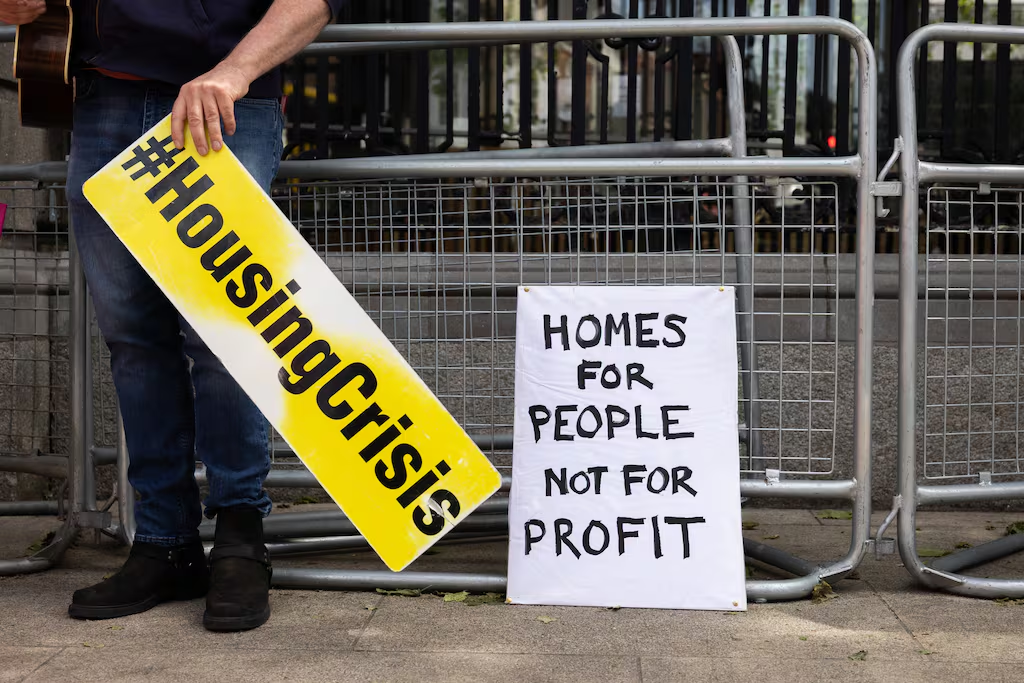
The Australian housing crisis is not a singular event but a chronic condition, a complex interplay of market forces, policy decisions, and demographic shifts that has been decades in the making. For retail and consumer insights specialists, its implications are profound, reshaping household budgets, altering spending patterns, and redefining the very concept of the Australian dream. The central question—whether this crisis will ever be solved—demands a move beyond political rhetoric and headline-grabbing announcements. It requires a forensic examination of the structural pillars underpinning the market and a sober assessment of whether genuine, politically palatable solutions exist to realign them. This analysis will dissect the core drivers, evaluate current interventions, and project the likely trajectory for Australian households and the businesses that serve them.
Deconstructing the Crisis: A Multi-Layered Problem
To understand the potential for resolution, we must first disaggregate the crisis into its constituent parts. It is not merely a problem of high prices, but a confluence of interrelated failures across supply, demand, and financing.
The Intractable Supply Deficit
The most cited and quantifiable element is the chronic undersupply of dwellings. The National Housing Supply and Affordability Council’s 2024 State of the Housing System Report is unequivocal: Australia needs to build 1.08 million new homes over the five years from 2024 to meet the projected demand under the National Housing Accord. This target of 216,000 homes per year stands in stark contrast to current completions. Based on my work with Australian SMEs in the construction and development sector, the barriers are systemic: lengthy and complex planning approvals, acute shortages of skilled labour, escalating material costs, and a development financing environment that has become exceedingly risk-averse. These are not issues solved by short-term demand-side stimulus.
The Demand-Side Avalanche
Supply constraints are only half the equation. Demand continues to be supercharged by powerful, persistent forces. Natural population growth, while slowing, continues. However, the restoration of high net overseas migration post-pandemic has been a significant accelerant. The Reserve Bank of Australia (RBA) has repeatedly noted that strong population growth, against a backdrop of limited new supply, is a primary driver of rental and price inflation. Furthermore, the structure of demand has shifted. From consulting with local businesses across Australia, I've observed the rise of the 'investor household'—where property investment is seen as the paramount vehicle for wealth creation, often supported by tax settings like negative gearing and the capital gains tax discount. This investment demand competes directly with, and often outbids, owner-occupier demand, particularly for established homes.
The Financing Chokehold: Interest Rates and Accessibility
The RBA’s aggressive monetary tightening cycle, lifting the cash rate from 0.10% in May 2022 to 4.35% by late 2023, was a necessary tool to combat inflation but a brutal shock to housing affordability. The Australian Prudential Regulation Authority (APRA) data shows that the increase in mortgage repayments has absorbed a historically high proportion of household disposable income. For prospective buyers, serviceability buffers have dramatically reduced borrowing capacity. A household that could borrow $1 million at 2% can now service a loan of only around $650,000 at 6%, a 35% reduction in purchasing power. This has created a perverse lock-in effect, discouraging existing homeowners from selling and further constraining turnover and effective supply.
Assumptions That Don’t Hold Up
Several comforting narratives persist in the public discourse, which a closer examination of data and on-the-ground reality quickly dispels.
- Myth: "Building more homes, anywhere, will solve the crisis." Reality: Location is paramount. Greenfield developments on city fringes often lack jobs, infrastructure, and services, creating commuter burdens and social inequity. The crisis is most acute in established inner and middle-ring suburbs where jobs and amenities are concentrated, but densification faces fierce local opposition. Simply hitting a national target does not guarantee the right homes are built in the right places.
- Myth: "A market correction or crash will restore affordability." Reality: A severe price collapse would likely be triggered by a deep recession and mass unemployment. In such a scenario, while prices may fall, access to finance would evaporate further, and fear would paralyse the market. First-home buyers would be just as locked out, if not more so, due to job insecurity. Affordability is a function of price, income, and credit; a crash typically destroys the latter two.
- Myth: "Government demand-side programs (e.g., First Home Owner Grants) are a long-term solution." Reality: These grants, while politically popular, are largely inflationary. By increasing the purchasing power of a subset of buyers without adding to supply, they bid up prices at the entry-level segment of the market. The benefit is often captured by vendors, not the intended recipients, as evidenced by numerous academic studies and RBA commentary.
Policy Levers: A Critique of Current and Proposed Interventions
Governments at all levels are deploying a toolkit of interventions. Their efficacy varies wildly, and trade-offs are inevitable.
Supply-Side Initiatives: The Long Game
The Federal Government's Housing Australia Future Fund and the $3.5 billion New Homes Bonus for states and territories aim to incentivise construction. In practice, with Australian-based teams I’ve advised, the feedback is that while welcome, these funds are a drop in the ocean compared to the scale of the deficit and do little to address the fundamental profitability challenges developers face amidst high costs. State-level planning reforms to accelerate approvals and allow greater density are more impactful but politically treacherous, often running into "not in my backyard" (NIMBY) resistance.
Demand-Side Manipulation: A Double-Edged Sword
Policies like the newly announced "Help to Buy" shared equity scheme attempt to bridge the deposit gap for first-home buyers. The risk, as seen with similar schemes overseas, is that they further fuel demand in a supply-constrained market, potentially pushing prices higher. Conversely, calls to reform negative gearing and capital gains tax concessions face fierce political opposition due to the large cohort of voter-investors. The 2019 federal election demonstrated the potency of this resistance. Drawing on my experience in the Australian market, any government attempting such reform would need to design a long, grandfathered transition to avoid a market shock, but the short-term political pain often outweighs the perceived long-term gain.
The Critical Role of Build-to-Rent (BTR)
One of the most promising, though nascent, innovations is the Build-to-Rent sector. By providing large-scale, institutionally owned, professionally managed rental stock, BTR offers security of tenure and quality that the fragmented "mum and dad" investor market often cannot. Having worked with multiple Australian startups in proptech, the data shows BTR can smooth out the cyclicality of construction. However, its growth is hampered by an unlevel playing field: BTR trusts face higher withholding tax rates compared to other property trusts (REITs), making large-scale investment less attractive. Regulatory change here is a low-hanging, high-impact policy lever.
The Consumer and Retail Impact: A Permanent Shift in Behaviour
For businesses, understanding the housing crisis is not an academic exercise; it's a vital input into consumer strategy. The crisis is fundamentally altering the Australian consumer psyche and spending calculus.
- The Great Wealth Divide: Homeownership has become the primary determinant of intergenerational wealth. Older, established homeowners have seen staggering equity growth, fueling confidence and discretionary spending. Younger cohorts, locked out of ownership and facing soaring rents, are in a perpetual state of budget compression. Retailers must segment not just by age, but by housing tenure.
- The Rental Economy Boom: As homeownership delays indefinitely, a generation is embracing a long-term rental lifestyle. This drives demand for rental-friendly furniture, flexible leasing models for appliances, and services that cater to a mobile population. The "IKEA effect" is being supplemented by a "subscription living" mindset.
- The Geographic Re-sort: High costs in major capitals are pushing migration to regional centres and more affordable states. This decentralisation creates new growth corridors for retail and services but requires sophisticated logistics and localised marketing strategies to capture.
Future Trajectory: A Realistic Outlook
Given the analysis, a definitive "solution" in the sense of a return to the affordability metrics of the 1990s is highly improbable. The more likely scenario is a managed, multi-decade rebalancing characterised by the following trends:
- A 'New Normal' of Lower Homeownership: Australia's historically high homeownership rate will likely decline permanently, aligning more closely with other developed nations like Germany and Switzerland, where long-term, high-quality renting is a norm, not a failure.
- The Rise of Multi-Generational Households and Alternative Models: Economic necessity will drive innovation in living arrangements. We will see a formalisation of multi-generational living (with purpose-built homes), a growth in co-living spaces, and increased policy focus on cooperative housing models.
- Policy Incrementalism Over Revolution: Sweeping, disruptive tax reforms remain politically unlikely. Progress will be piecemeal: tweaks to BTR regulations, targeted incentives for affordable housing provision, and gradual planning reforms. The focus will increasingly shift from promoting homeownership to securing the rental tenures of those who will remain lifelong tenants.
- Sustained Pressure on Consumer Discretionary Spending: For a significant portion of the population, housing costs (whether mortgage or rent) will continue to claim a historically high share of income. This creates a persistent headwind for non-essential retail and places a premium on value, durability, and subscription-based services that offer predictable costs.
Final Takeaway & Call to Action
The Australian housing crisis is a structural feature of the modern economy, not a temporary bug. It will not be "solved" by a silver-bullet policy but may be gradually ameliorated through a sustained, coherent, and politically courageous multi-pronged strategy that prioritises supply in the right places, reforms tenancy laws to provide security, and rebalances the tax system to favour productive investment over speculative leverage.
For business leaders and consumer insights professionals, the imperative is to internalise this reality. Your strategic planning, customer segmentation, and product development must account for a nation increasingly divided by housing tenure, with spending patterns and lifestyle aspirations fundamentally shaped by this single, overwhelming cost of living factor. The businesses that thrive will be those that adapt to serve the needs of both the asset-rich and the income-poor, recognising that the Australian dream has fractured into multiple, parallel realities.
What’s your strategic read on the housing crisis’s impact on your sector? Have you observed distinct behavioural shifts in your customer base correlated to housing stress? Share your insights and observations below to deepen this critical industry discussion.
People Also Ask
What is the main cause of Australia's housing crisis? The crisis is primarily caused by a persistent and significant shortfall in new housing supply, particularly in well-located areas, failing to keep pace with strong demand driven by population growth and tax-advantaged investment. It is a structural supply-demand imbalance, not a temporary market fluctuation.
Will house prices ever go down in Australia? Nominal house prices may experience periods of correction, but a sustained, dramatic decline is unlikely without a severe economic recession. The long-term trend, driven by supply constraints and population growth, points to ongoing increases, though future growth rates may moderate from the highs of recent decades.
What can the government actually do to fix the housing crisis? Governments can drive reforms to accelerate planning and zoning approvals, incentivise higher-density development near transport hubs, review tax settings that favour speculative investment, and support institutional investment in the Build-to-Rent sector. Success requires coordinated, long-term action across all three levels of government.
Related Search Queries
- Australia housing crisis explained 2024
- When will Australian house prices drop
- Impact of interest rates on Australian housing
- Build to Rent Australia benefits
- First home buyer schemes Australia pros and cons
- Negative gearing reform Australia
- Rental market forecast Australia 2025
- Affordable housing solutions Australia
- Population growth Australia housing impact
- State government housing policies Australia
For the full context and strategies on Will Australia’s Housing Crisis Ever Be Solved? – What Aussie Professionals Should Know, see our main guide: Hotel Accommodation Videos Australia.

































Prazna Foundation
4 months ago