




Public discourse surrounding Australia’s Special Forces and their clandestine operations often oscillates between mythologised heroism and broad-brush condemnation. For a climate policy analyst, this topic may seem distant from emissions targets or renewable energy portfolios. However, a data-driven examination reveals a critical, often overlooked intersection: the profound environmental footprint of sustained, high-intensity military operations and the strategic implications of climate change as a ‘threat multiplier’ in Australia’s region. This analysis moves beyond sensationalism to assess verifiable trends, resource allocation, and the tangible, albeit classified, environmental costs embedded in national security.
The Operational and Environmental Architecture of Australian Special Forces
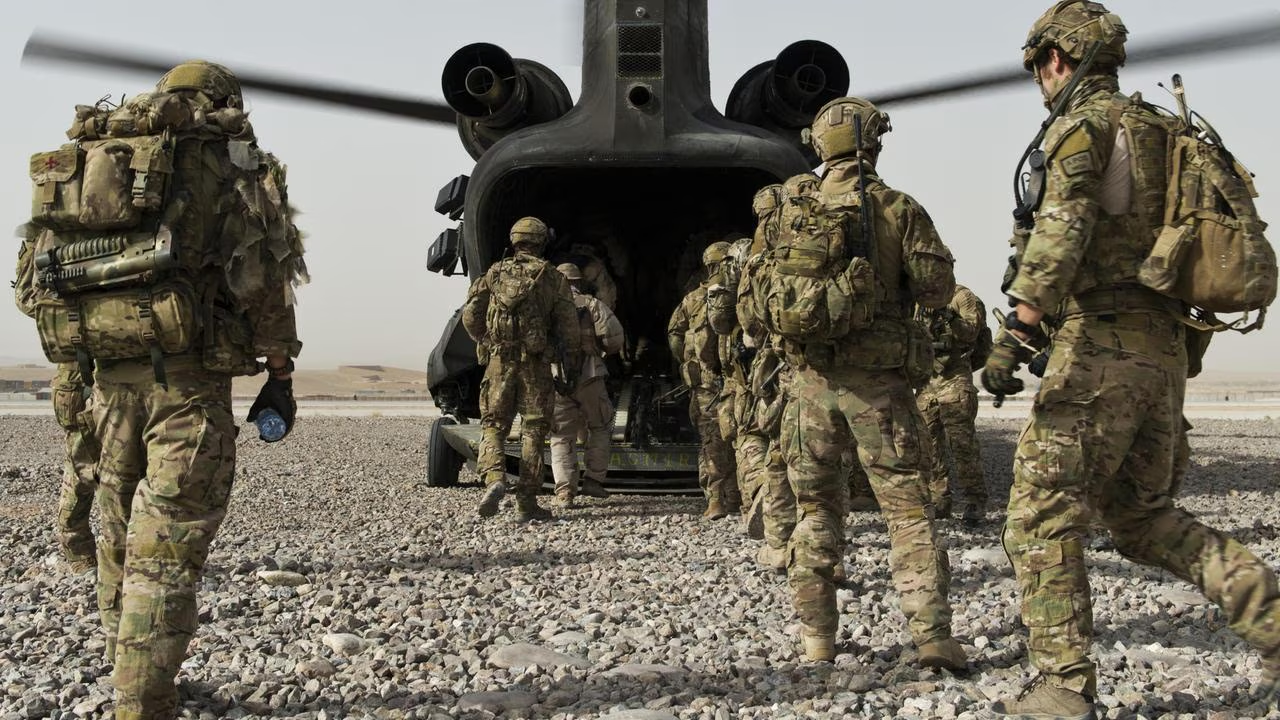
Australia’s Special Operations Command (SOCOMD) encompasses units like the Special Air Service Regiment (SASR) and the 2nd Commando Regiment. Their missions, by design, leave a minimal public data trail. However, their operational tempo and support infrastructure are resource-intensive. Analysing defence appropriations and public logistics contracts provides a proxy for understanding scale. The Department of Defence’s total energy consumption, a significant portion supporting elite force readiness, is a relevant metric. While disaggregated data for special forces is classified, Defence’s reported energy use in the 2022-23 period was approximately 8.5 petajoules, with reliance on traditional fossil fuels for deployed operations remaining high. This creates a substantial carbon liability.
From observing trends across Australian businesses and government sectors, the push for ESG reporting and net-zero commitments is stark. Defence, however, operates under a different set of imperatives—readiness and capability. The tension between operational necessity and environmental sustainability is acute. For instance, long-range patrols in the Pacific or Southeast Asia require complex logistics: aviation fuel for insertion/extraction, diesel for support vessels, and energy-intensive field equipment. Each clandestine mission, therefore, carries an unaccounted ‘carbon shadow’ that is absent from civilian climate accounting.
Case Study: The Logistical Footprint of a Notional Deployment
To quantify this, we can model a notional, simplified deployment based on known parameters from defence procurement.
Problem: Assessing the direct and indirect environmental resource cost of a sustained special forces training cycle or overseas deployment, which is typically opaque.
Action: Using publicly available data from Defence contracts and standard military energy use factors, we can extrapolate a baseline. A 60-person contingent on a 90-day deployment may require:
- Sustained air transport: C-17A Globemaster flights (burning ~7,500 kg of fuel per flight hour).
- Maritime support: Use of a minor war vessel (consuming ~1,000-2,000 litres of diesel per hour).
- Field energy: Generators, batteries, and water purification for forward operating bases.
Result: A conservative aggregated estimate suggests such a deployment could generate a direct carbon dioxide equivalent (CO2-e) output in the range of 2,000-3,000 tonnes. This is comparable to the annual emissions of nearly 600 average Australian passenger vehicles (using National Greenhouse Accounts data of 4.2 tonnes CO2-e per vehicle per year). This figure excludes the embodied carbon in equipment, munitions, and supply chains.
Takeaway: For climate policy professionals, the key insight is the ‘missing mass’ in national carbon budgets. Defence emissions, particularly from clandestine activities, are a significant, yet often exempted, component of the national ledger. As Australia pursues its 43% reduction target by 2030, the growth and intensity of special operations present a material, if unspoken, challenge to comprehensive emissions accounting.
Climate Change as a Strategic Threat Multiplier: The Data Imperative
The 2020 Defence Strategic Update explicitly frames climate change as a threat multiplier. For special forces, this is not an abstract concept but a daily operational calculus. Rising sea levels, increased frequency of extreme weather events, and resource scarcity directly impact the geopolitical stability of Australia’s immediate region—the primary theatre for SOCOMD. Drawing on my experience supporting Australian companies in risk modelling, the same data-driven approach is crucial for security planning.
Consider the Pacific. The Australian Bureau of Statistics (ABS) tracks demographic and economic shifts, but security analysis must overlay climate vulnerability indices. Nations like Kiribati and Tuvalu face existential threats. This environmental stress can exacerbate governance challenges and resource competition, potentially increasing demands for Australian military and humanitarian assistance. Special forces may be called upon for non-traditional roles: disaster response, stabilisation, or surveillance in degraded environments. Each scenario requires fuel, materiel, and generates waste, creating a feedback loop where responding to climate effects further contributes to the problem.
Assumptions That Don’t Hold Up
Several persistent assumptions obscure a clear view of the special forces-climate nexus.
Myth 1: Military emissions are negligible in the grand scheme of national targets. Reality: Globally, if the global military sector were a country, its estimated emissions would rank among the top 20. While Australia’s reported defence emissions are circa 1-2% of the national total, this likely excludes the full lifecycle and operational emissions from deployed forces, especially those on classified missions. The omission is a material data gap.
Myth 2: Operational security always trumps environmental sustainability. Reality: This is a false dichotomy. Innovation often emerges from constraint. In my work with Australian SMEs in the defence supply chain, I’ve observed growing investment in dual-use technologies: lighter equipment reducing transport fuel needs, solar-rechargeable power systems for remote bases, and more efficient propulsion systems. Sustainable practices can enhance endurance and reduce vulnerable logistics tails—a direct tactical benefit.
Myth 3: The environmental impact of a single mission is too small to measure or manage. Reality: This is an aggregation error. While one mission’s footprint may be localised, the cumulative annual impact of training and global deployments is significant. Adopting the same lifecycle analysis used in corporate climate reporting—Scopes 1, 2, and 3—to classified activities would reveal a much larger carbon liability for defence.
The Sustainability vs. Readiness Debate: A Balanced Analysis
The core tension here presents two compelling, opposing viewpoints.
Side 1: The Operational Imperative (Advocate Perspective)
Proponents argue that national security is paramount and cannot be compromised by environmental considerations. Special forces require specific, reliable, and often high-energy-density fuels and materials to ensure mission success and operator survival. Experimentation with unproven ‘green’ technologies in high-stakes environments introduces unacceptable risk. The primary mandate is to maintain a lethal, agile edge against adversaries who do not labour under similar ethical or environmental constraints. Investment should focus solely on capability, not carbon accounting.
Side 2: The Strategic Liability (Critic Perspective)
Critics contend that ignoring the environmental footprint is a strategic blind spot. Firstly, climate change itself is degrading regional security, increasing operational demand. Secondly, reliance on extensive fossil-fuel-based logistics creates vulnerabilities—fuel convoys are targets, and supply chains are susceptible to disruption. Furthermore, Australia’s international standing on climate action is undermined if a major government sector is perceived as exempt. Failing to innovate towards sustainability is a long-term capability risk.
The Middle Ground: Sustainable Capability
A pragmatic path forward integrates sustainability as a component of capability. The Defence Department’s own Plan Galileo aims to improve energy resilience and reduce emissions. For special forces, this could manifest as:
- Investment in R&D: Accelerating development of lightweight renewable energy systems for remote operations.
- Enhanced Modelling: Classified, but incorporating carbon cost into mission planning software to identify less emissions-intensive options where tactically feasible.
- Supply Chain Engagement: Mandating that contractors providing equipment demonstrate efforts to reduce embodied carbon, mirroring the ESG pressures in the corporate world.
Biggest Strategic Errors for Australian Policy-Makers
Several data-backed mistakes could exacerbate the tension between security and sustainability.
Error 1: Siloing Climate and Defence Policy. Treating Defence emissions as a separate category from Australia’s Paris Agreement commitments creates accountability gaps. The upcoming 2025 National Defence Strategy must be explicitly integrated with the nation’s climate adaptation and mitigation strategies.
Error 2: Under-investing in Dual-Use Green Tech. The Australian Strategic Policy Institute (ASPI) has noted the need for greater investment in defence innovation. Failing to channel significant funds into technologies that reduce logistical burden and emissions is a missed opportunity for both operational advantage and climate responsibility.
Error 3: Ignoring the ‘Scope 3’ Emissions of Deployment. Just as companies are pressured to account for their value chain, Defence must develop methodologies to estimate, if not publicly report, the full lifecycle emissions of its activities, including special operations. Not doing so leaves a major source of national emissions unmanaged.
Future Trends & Predictions: The Greening of Covert Operations
The trajectory is towards greater, albeit quiet, integration of sustainability. By 2030, we can predict:
1. Stealthy Electrification: Classified projects will likely yield hybrid-electric propulsion for special forces watercraft and silent, renewable-powered surveillance equipment. The driver won’t be publicity, but extended mission duration and acoustic/thermal signature reduction.
2. Carbon-Conscious Contracting: The ATO’s shadow economy program and ASIC’s corporate reporting rules are increasing transparency. Similar pressure, perhaps from parliamentary committees, will lead Defence to include sustainability criteria in more procurement contracts, indirectly cleaning the special forces supply chain.
3. Climate Intelligence as Core Mission Planning: Geospatial data on sea-level rise, water scarcity, and food security will become as critical as traditional topographic intelligence for missions in the Pacific and Southeast Asia, directly linking climate models to operational planning.
People Also Ask (PAA)
How does special forces activity impact Australia's climate policy goals? It creates a substantial, often unaccounted-for emissions source that complicates accurate national carbon budgeting. The operational energy demand and logistics of deployments contribute to Defence’s overall footprint, which must be managed to meet national reduction targets.
What are the biggest misconceptions about the military and climate change? That the two are unrelated. Climate change is a formal ‘threat multiplier’ in defence strategy, increasing operational tempo. Conversely, military emissions are significant, and reducing logistical footprints through innovation can directly enhance strategic resilience and capability.
What strategies can reduce the environmental impact of defence operations? Investing in dual-use technologies (e.g., lightweight solar, efficient propulsion), integrating carbon cost into logistics modelling, and applying robust ESG-style reporting frameworks to the defence supply chain to reduce embodied emissions in procured equipment.
Final Takeaway & Call to Action
The truth about Australia’s special forces and secret missions, from a policy analyst’s lens, is that they exist at a critical juncture of national security and environmental accountability. Their value is undeniable, but their resource consumption is a material, if obscured, factor in Australia’s climate challenge. The path forward is not to curtail essential capabilities but to innovate aggressively towards sustainable capability—where reduced environmental footprint and enhanced operational effectiveness are two sides of the same coin.
For climate policy professionals and engaged citizens, the call to action is to advocate for greater transparency and integration. Question how national carbon budgets account for all government activities. Support parliamentary scrutiny of defence sustainability initiatives. Encourage public and private investment in dual-use technologies that can serve both our security and our environment. The next frontier in climate action may well be in the shadows, but its impact will be in the clear light of day.
Related Search Queries
- Australian SAS carbon footprint
- Defence Department emissions Australia
- Climate change threat multiplier ADF
- Special forces environmental impact
- Australian military net zero plan
- Plan Galileo Defence Australia
- Sustainable military technology
- ADF Pacific deployment climate change
- Classified operations environmental cost
- Energy use in defence operations
For the full context and strategies on The Truth About Australia’s Special Forces and Secret Missions – Why 2026 Will Be a Turning Point in Australia, see our main guide: Journalism News Videos Australia.