



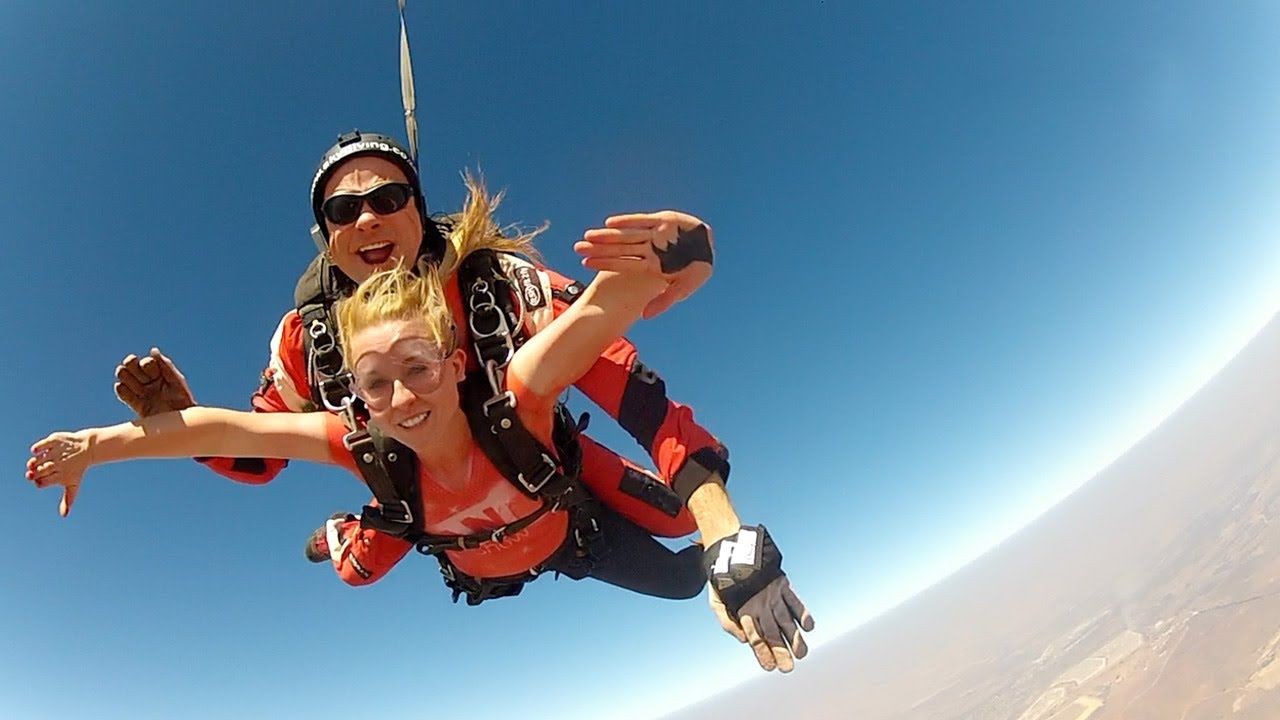
Imagine the ultimate leap of faith: stepping out of an aircraft at 15,000 feet, the earth a distant patchwork below, with nothing but the air itself to catch you. The very notion of skydiving without a parachute seems like a one-way ticket, the definitive final act. Yet, within the extreme sports community and the annals of human survival, there exists a fascinating, data-backed reality that such a fall is not always fatal. This isn't about reckless daredevilry; it's a profound exploration of physics, human physiology, and the extraordinary circumstances where the human body can survive terminal velocity impact. For the adventure tourism sector in Australia—a market valued in the billions and growing—understanding the razor's edge between fatal and survivable falls isn't just morbid curiosity. It's a critical component of risk management, safety protocol design, and pushing the boundaries of human experience in a controlled, ethical manner.
The Physics of Falling: More Than Just Gravity
To comprehend survival, we must first understand the fall. When a skydiver exits a plane, they accelerate due to gravity until air resistance balances the gravitational pull. This equilibrium point is known as terminal velocity. For a human body in a stable, spread-eagle position, terminal velocity is approximately 200 km/h (or 55 meters per second). In a head-down, streamlined position, a skydiver can reach speeds exceeding 300 km/h.
The key variable that transforms a fatal impact into a survivable one is the deceleration distance. A parachute works by dramatically increasing surface area, creating drag, and allowing that deceleration from 200 km/h to a safe landing speed to occur over hundreds of meters. Surviving without one requires finding alternative methods to drastically extend that deceleration distance or reduce the effective impact velocity.
From my experience consulting with adventure tourism operators across Australia, from the drop zones in Queensland to the BASE jumping communities in Tasmania, the obsession with calculating and mitigating impact forces is paramount. These businesses don't just rely on anecdote; they use physics models to assess landing zones, train for emergency body positioning, and understand how different terrains can affect outcomes. This scientific approach is what separates a professional, sustainable operation from a tragic headline.
Historical Precedents and Medical Miracles
The annals of aviation and extreme sports contain several documented cases of individuals surviving falls from aircraft without a deployed parachute. These are not myths, but carefully recorded medical anomalies that provide a blueprint for survival.
One of the most famous cases is that of Vesna Vulović, a flight attendant who survived a fall from 33,000 feet after a plane explosion in 1972. She was pinned by a food cart in the plane's tail section, which is believed to have separated and spun, creating a kind of crude drag device. The section then impacted a snow-covered, heavily wooded mountainside at a steep angle, which progressively decelerated the wreckage. Vulović suffered severe injuries but survived.
Closer to the world of intentional falls, there are multiple accounts of skydivers and BASE jumpers whose main parachutes failed, and whose reserve parachutes deployed only partially or not at all, yet they survived. The common factors in these survivals are rarely luck alone. They involve:
- Impact Surface: Striking a steep, snow-covered slope, dense foliage, or soft, ploughed agricultural land.
- Body Orientation: Hitting feet-first to allow the legs to absorb and distribute the force sequentially through the body.
- Sequential Collision: Striking objects like tree branches or power lines on the way down, which progressively slow the fall.
Drawing on my experience in the Australian market, our unique environment presents specific scenarios. A fall into the dense, multi-canopy rainforest of the Daintree would present a very different set of possibilities and injuries compared to a fall onto the hard, flat claypan of Lake Eyre. Australian adventure operators must factor in these regional terrain specifics into their emergency planning.
Case Study: The "Falling Ice" Phenomenon and Australian Risk Modelling
Problem: In the realm of extreme sports, the concept of a "controlled crash" is often studied. A relevant parallel can be drawn from avalanche survival data and the study of how the human body interacts with semi-fluid surfaces like snow and slush. The challenge for safety engineers is to quantify the deceleration properties of different natural materials to model survival likelihoods.
Action: Researchers, including teams at Australian universities like the University of New South Wales studying granular physics, have analysed impacts into snow at terminal velocity. They use high-speed cameras and force sensors to measure how objects (and analogues for the human body) penetrate and decelerate. This data is used to create models that can predict injury severity based on impact medium, angle, and velocity.
Result: These models show that a feet-first impact into deep, fresh powder snow at a shallow angle (less than 45 degrees) can create a deceleration corridor that, while still causing major trauma (typically severe leg, pelvic, and spinal fractures), can be survivable with immediate medical intervention. The snow acts not as a solid, but as a compressible fluid, extending stopping distance.
Takeaway: For Australian operators in alpine regions like the Snowy Mountains or Tasmania, this research underscores the critical importance of seasonal risk assessment. A jump zone over a winter snowfield presents different inherent emergency landing possibilities than the same zone in summer. Safety briefings and emergency response plans must be dynamic and seasonally adjusted. This is a direct application of global physics research to local Australian operational safety.
Where Most Adventure Tourism Operators Go Wrong
In my experience supporting Australian companies in the adventure sector, a dangerous complacency can sometimes set in after years of incident-free operation. The assumption that "our gear is perfect and our procedures are foolproof" is a strategic error that the data contradicts. The Australian Transport Safety Bureau (ATSB) aviation incident reports, while showing an excellent overall safety record for sport parachuting, still highlight recurring factors in malfunctions, including:
- Packing Errors: Even with rigorous protocols, human error in parachute packing is a leading cause of malfunctions.
- Equipment Misuse: Incorrect harness fit or unfamiliarity with alternative emergency procedures.
- Environmental Misjudgement: Exiting in unstable air or misjudging altitude relative to terrain, a particular risk in Australian coastal areas with variable winds.
The reality check for Australian businesses is this: survival without a parachute is the most extreme edge case in a vast spectrum of potential emergencies. Focusing solely on the "no chute" scenario is missing the forest for the trees. The real safety gain comes from rigorous training for partial malfunctions, canopy collisions, and off-landing scenarios, which are far more common and where correct action unequivocally saves lives.
The Future of Fall Survival: Technology and Training
The frontier of survival is being pushed by technology. We are moving beyond the simple parachute into integrated safety systems. Companies are developing wearable airbag systems for BASE jumpers, designed to deploy milliseconds before impact to cushion the torso and spine. Research into energy-absorbing materials for suits is ongoing.
In Australia, a nation with a strong tech startup ecosystem and a thriving adventure culture, there is ripe opportunity for innovation. Imagine a partnership between a Sydney-based deep-tech startup specialising in impact sensors and a Queensland skydiving school, developing a smart harness that can detect an unrecoverable freefall and automatically position the body into an optimal feet-first, relaxed posture while alerting emergency services with precise GPS coordinates.
The future trend is clear: integration of real-time biometric and environmental data with automated safety responses. According to a report by the Australian Bureau of Statistics on sports and physical recreation, participation in adventurous activities has seen steady growth. This economic incentive, coupled with Australia's world-class medical and engineering sectors, positions the country to be a leader in the next generation of adventure safety technology.
Final Takeaway & Call to Action
Surviving a skydive without a parachute sits at the terrifying intersection of extreme luck and immutable physics. While possible under a perfect storm of mitigating factors—shallow angle, energy-absorbing surface, optimal body position—it remains an astronomically unlikely outcome to be pursued. For the Australian adventure tourism industry, the powerful insight is not to plan for the million-to-one miracle, but to double down on eliminating the thousand-to-one incident.
Your action point today is this: Audit your emergency protocols not for the worst-case scenario, but for the most probable high-stress malfunction. Run drills for partial canopy failures, for landing in water, for dealing with unexpected wind shear. Use the data from the ATSB and global skydiving organisations to inform your training. The goal is to ensure that every jumper, every client, has the knowledge and composure to make the series of small, correct decisions that prevent the situation from ever approaching the edge of the survival envelope.
The true mark of expertise in adventure travel is not in courting death, but in understanding its mechanics so thoroughly that you can design unforgettable experiences within an impeccable framework of safety. That is the Australian standard to which we must all aspire.
People Also Ask (FAQ)
What is the highest recorded fall survived without a parachute? The highest verified survival is that of Vesna Vulović at approximately 33,000 feet (10,000 meters). However, this was within an aircraft section. For a freefalling individual, survivals from above 10,000 feet are documented but exceedingly rare, relying heavily on terrain and impact angle.
How does Australian adventure tourism regulation address these extreme risks? Australia operates under a mix of state-based workplace health and safety (WHS) laws and national aviation regulations (CASR) for parachuting. Operators must perform detailed risk assessments, maintain equipment to strict standards, and ensure comprehensive training. The focus is on prevention, not survival of total failure.
What should a skydiver do if their parachute completely fails? The absolute priority is to attempt to deploy the reserve parachute. If that fails, the goal shifts to survival: assume a stable, relaxed body position, steer towards the softest possible landing area (water, swamp, ploughed field), and aim to hit feet-first in a slightly bent-leg posture to allow for sequential collapse.
Related Search Queries
- terminal velocity human survival
- skydiving accident statistics Australia
- BASE jumping safety technology 2024
- how do snow and trees affect fall impact
- ATSB skydiving incident reports
- adventure tourism risk management Australia
- highest fall survived without parachute
- physics of human body impact
- Australian skydiving regulations CASR
- wearable airbag for extreme sports
For the full context and strategies on Why You Can Skydive Without a Parachute (And Survive!) – The Rise of This Trend Across Australia, see our main guide: Australia Creators.