





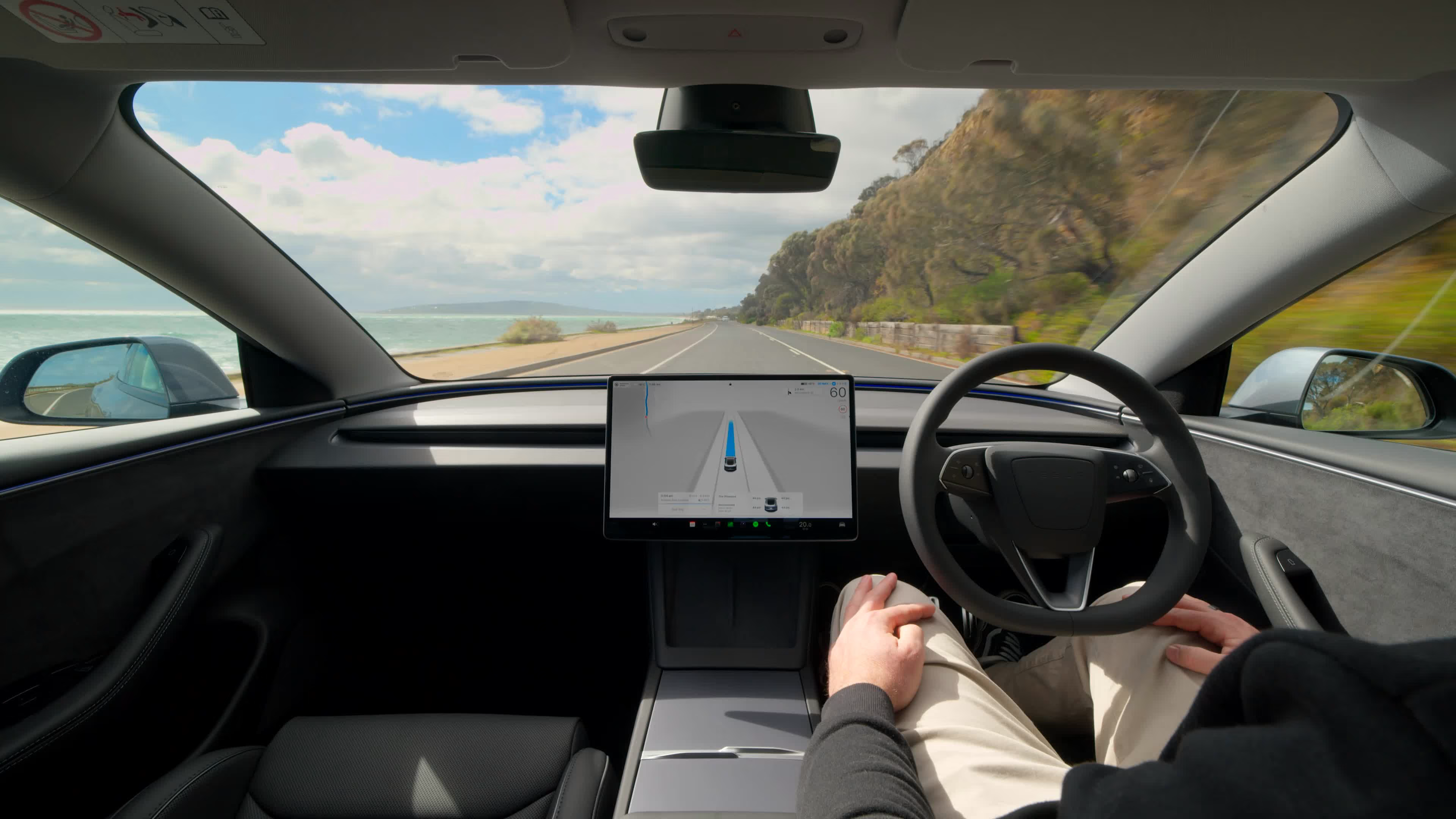
Did you ever imagine the day when self-driving cars would be navigating the roads of New Zealand, seamlessly integrating into the daily commute of Kiwis? While the concept sounds futuristic and promising, the reality is that self-driving cars may not be gracing New Zealand's landscapes anytime soon. This analysis delves into the nuanced factors contributing to this delay, exploring the economic, regulatory, and technological challenges specific to New Zealand's context.
The Ultimate 2026 Strategy for New Zealanders
For more than a decade, self-driving cars have been framed as an inevitability. Global technology firms, automotive manufacturers, and venture-backed startups have promised safer roads, cheaper transport, and a future where human drivers are largely optional. Yet in New Zealand, that future remains distant. Despite advances overseas, fully autonomous vehicles are unlikely to become a mainstream reality for Kiwis in the near term.
This matters now because expectations are colliding with reality. Policymakers are being asked to prepare for automation, councils are considering infrastructure investments, and businesses are assessing long-term transport strategies. At the same time, the public narrative often underestimates how New Zealand’s unique geography, regulatory environment, and market structure complicate the rollout of self-driving technology. Understanding why progress is slow is essential to making realistic decisions about what comes next.
The Global Progress Gap and Why New Zealand Feels It More
Internationally, autonomous vehicle development has been uneven. While limited self-driving systems operate in tightly controlled environments in parts of the United States and China, even those markets have struggled to scale beyond pilot zones. The technology performs best in dense urban areas with predictable road layouts, extensive mapping, and constant software refinement.
New Zealand sits at the opposite end of that spectrum. Roads range from modern motorways to narrow rural highways, often with inconsistent signage, variable weather, and frequent interactions with livestock, cyclists, and pedestrians. These conditions present edge cases that autonomous systems find particularly difficult to manage.
Because New Zealand is a small market, it is rarely prioritised for early deployment. Autonomous systems require extensive local testing and mapping to function safely. For global developers, the cost of tailoring technology to New Zealand’s road network is hard to justify without large-scale commercial returns. As a result, Kiwi roads are not high on the list when companies decide where to expand next.
Infrastructure Realities on New Zealand Roads
Self-driving vehicles rely on more than onboard sensors. They perform best when supported by high-quality road markings, consistent signage, reliable digital mapping, and robust connectivity. In New Zealand, infrastructure quality varies widely between regions.
Many rural and provincial roads lack the clear lane markings and standardised layouts that autonomous systems depend on. Weather adds another layer of complexity. Heavy rain, fog, glare, and gravel surfaces interfere with sensors and cameras, increasing the risk of misinterpretation. Even in urban centres, ongoing roadworks and temporary traffic management can confuse systems trained on static maps.
Upgrading infrastructure to autonomous-ready standards would require sustained investment. For councils already struggling to fund basic maintenance and water services, prioritising automation-friendly roads is politically and economically challenging. Without that foundational work, large-scale deployment of self-driving cars remains impractical.
Regulatory and Legal Barriers
New Zealand’s transport laws are built around the assumption of a human driver. Responsibility for vehicle control, liability in crashes, and compliance with road rules all rest on that premise. Introducing self-driving vehicles requires more than technical approval; it demands a rethinking of legal accountability.
Questions around who is responsible when an autonomous system fails remain unresolved. Is it the vehicle owner, the software provider, or the manufacturer? In a country with a strong focus on public safety and clear liability frameworks, ambiguity is a significant barrier. Regulators have been cautious, allowing limited trials but stopping short of enabling widespread use.
There is also the matter of public trust. New Zealand’s road safety culture is shaped by campaigns emphasising personal responsibility. Transitioning to systems where control is delegated to algorithms challenges that mindset. Without broad social confidence and clear rules, policymakers are unlikely to move quickly.
Economics in a Small, Distributed Market
Even if the technology and laws were ready, the economics are difficult. New Zealand’s population is spread across a large land area, reducing the efficiency gains that autonomous vehicles promise in dense cities overseas. The business case for fleets of self-driving taxis or delivery vehicles weakens when utilisation rates are low and distances are long.
Vehicle affordability is another constraint. Autonomous systems significantly increase vehicle costs. In a market where many households already struggle with transport expenses, widespread uptake would be slow. Fleet operators, such as logistics companies, might adopt automation earlier, but only if reliability is proven under local conditions.
This economic reality shapes strategy. Rather than pursuing full autonomy, New Zealand is more likely to see gradual adoption of advanced driver assistance systems that enhance safety without removing human control. These incremental steps deliver tangible benefits without requiring wholesale change.
Cultural and Behavioural Factors
New Zealand’s driving culture also matters. Many Kiwis value personal control and adaptability on the road, particularly in rural areas where conditions can change rapidly. Trusting a machine to navigate winding roads, unpredictable weather, or wildlife crossings is a psychological hurdle as much as a technical one.
There is also a strong DIY and problem-solving mindset among drivers. People are accustomed to making judgement calls that automated systems struggle to replicate. Until autonomous vehicles demonstrate clear superiority in these contexts, resistance will remain.
What a Realistic 2026 Strategy Looks Like
Rather than waiting for fully self-driving cars, New Zealand’s most practical strategy through 2026 focuses on selective, incremental adoption. Advanced safety features such as adaptive cruise control, lane assistance, collision avoidance, and driver monitoring systems are already improving outcomes. Encouraging uptake of these technologies delivers immediate benefits without overpromising autonomy.
Targeted trials also have a role. Autonomous shuttles in controlled environments, such as campuses, ports, or industrial sites, allow learning without exposing the public to undue risk. These use cases align better with New Zealand’s scale and regulatory caution.
From a policy perspective, the priority is building flexible frameworks rather than rushing to legislate for full autonomy. Updating laws to accommodate assisted driving, clarifying data governance, and investing in digital infrastructure lays groundwork without locking the country into premature solutions.
For businesses, the focus should be on productivity gains that do not depend on full autonomy. Logistics optimisation, fleet telematics, and semi-automated systems offer measurable returns now. Waiting for driverless vehicles risks delaying improvements that are already available.
The Next Three to Five Years
By the late 2020s, New Zealand is unlikely to see widespread self-driving cars on public roads. What it will see is a gradual normalisation of automation as a support, not a replacement, for human drivers. Safety systems will become standard, data-driven traffic management will improve, and limited autonomous applications will operate in niche settings.
This trajectory reflects realism rather than reluctance. New Zealand’s size, infrastructure, and values favour cautious integration over rapid disruption. The technology will arrive eventually, but on local terms, shaped by practical constraints rather than global hype.
Understanding New Zealand's Unique Landscape
New Zealand, with its picturesque landscapes and diverse terrains, presents a unique challenge to the implementation of self-driving cars. The country's infrastructure, characterized by narrow roads and less population density, is not conducive to the extensive testing and deployment of autonomous vehicles. Moreover, the integration of self-driving technology requires significant investment in road infrastructure and digital mapping, areas where New Zealand currently lags behind.
Economic Considerations
- High Initial Costs: The deployment of self-driving cars necessitates substantial financial investment. According to the Ministry of Business, Innovation and Employment (MBIE), the cost of updating infrastructure to accommodate autonomous vehicles could burden the economy, diverting funds from other critical sectors.
- Market Size: New Zealand's relatively small market size poses a challenge. Unlike larger markets such as the United States or China, New Zealand may not offer the economies of scale necessary to justify the high costs associated with self-driving technology.
- Economic Priorities: With pressing issues such as housing affordability and healthcare, the New Zealand government may prioritize other sectors over investing in cutting-edge automotive technology, further delaying the adoption of self-driving cars.
Regulatory and Policy Challenges
New Zealand's regulatory environment, while supportive of innovation, is not fully equipped to handle the complexities of autonomous vehicles. The country's current traffic laws and insurance policies would require significant amendments to accommodate self-driving cars. Furthermore, public acceptance and trust in autonomous technology remain low, as evidenced by a 2023 survey by Stats NZ, which found that only 45% of New Zealanders are open to the idea of self-driving cars.
Case Study: The Global Perspective
While New Zealand grapples with these challenges, other countries are making strides in autonomous vehicle technology. For instance, the United States has made significant progress, with companies like Waymo and Tesla leading the charge. However, even in these tech-forward regions, challenges persist, illustrating the complexity of the issue.
Case Study: Waymo – Navigating Regulatory Challenges
Waymo, a leader in self-driving technology, faced a myriad of regulatory challenges in the United States. Despite this, they successfully collaborated with local governments to roll out their autonomous taxi service. This highlights the importance of regulatory adaptation and government collaboration, lessons that could be invaluable for New Zealand as it navigates its path toward autonomous vehicles.
Pros and Cons of Self-Driving Cars in New Zealand
Pros:
- Enhanced Safety: Autonomous vehicles have the potential to reduce accidents caused by human error, which accounts for 94% of all road accidents globally.
- Environmental Impact: Self-driving cars could lead to more efficient driving patterns, reducing fuel consumption and emissions, aligning with New Zealand's sustainability goals.
- Innovation Hub Potential: Adoption of self-driving technology could position New Zealand as a leader in automotive innovation within the Asia-Pacific region.
Cons:
- Infrastructure Overhaul: Significant upgrades to road infrastructure and digital connectivity are required, posing a financial and logistical challenge.
- Public Skepticism: Gaining public trust is a significant hurdle, with many New Zealanders remaining cautious about the safety and reliability of autonomous vehicles.
- Job Displacement: The rise of autonomous vehicles could potentially lead to job losses in the transportation sector, affecting livelihoods.
Debunking Common Myths
Several misconceptions surround the adoption of self-driving cars in New Zealand:
- Myth: "Self-driving cars will eliminate all road accidents." Reality: While they can reduce human error, technical malfunctions and cybersecurity threats remain potential risks.
- Myth: "They are ready for immediate deployment." Reality: The technology requires extensive testing and adaptation to New Zealand's unique road conditions.
- Myth: "Cost savings will be immediate." Reality: Initial costs are high, and savings will only become apparent over time as the technology matures.
Future Trends and Predictions
Looking ahead, the global autonomous vehicle market is projected to grow significantly. According to Deloitte's 2024 report, the global market could reach USD 500 billion by 2030. However, for New Zealand to participate in this growth, strategic investments in infrastructure and regulatory reform are crucial. By 2028, it is predicted that only 20% of New Zealand's vehicles will be autonomous, highlighting the need for a measured approach.
Conclusion
Self-driving cars are not stalled in New Zealand because of a lack of ambition or innovation. They are constrained by geography, infrastructure, economics, regulation, and culture. For Kiwis, recognising these realities is essential to making smart decisions about transport investment and policy.
The most effective strategy for 2026 is not to chase full autonomy, but to focus on technologies that genuinely improve safety, efficiency, and resilience today. In doing so, New Zealand can prepare for a more automated future without sacrificing trust, affordability, or practicality along the way.
In conclusion, while the prospect of self-driving cars in New Zealand is enticing, several hurdles must be overcome before they become a reality. From economic constraints to regulatory challenges, the road ahead is complex. However, by learning from global examples and investing strategically, New Zealand can position itself to embrace this technological shift. What are your thoughts on the future of self-driving cars in New Zealand? Share your insights below!
Related Search Queries
- Future of self-driving cars in New Zealand
- Autonomous vehicle regulations NZ
- Impact of self-driving cars on NZ economy
- Sustainability benefits of autonomous vehicles
- Technological challenges for self-driving cars in NZ
For the full context and strategies on Why Self-Driving Cars May Not Be Coming to New Zealand Anytime Soon – The Ultimate 2026 Strategy for New Zealanders, see our main guide: Wildlife Nature Tourism Videos Aotearoa.