






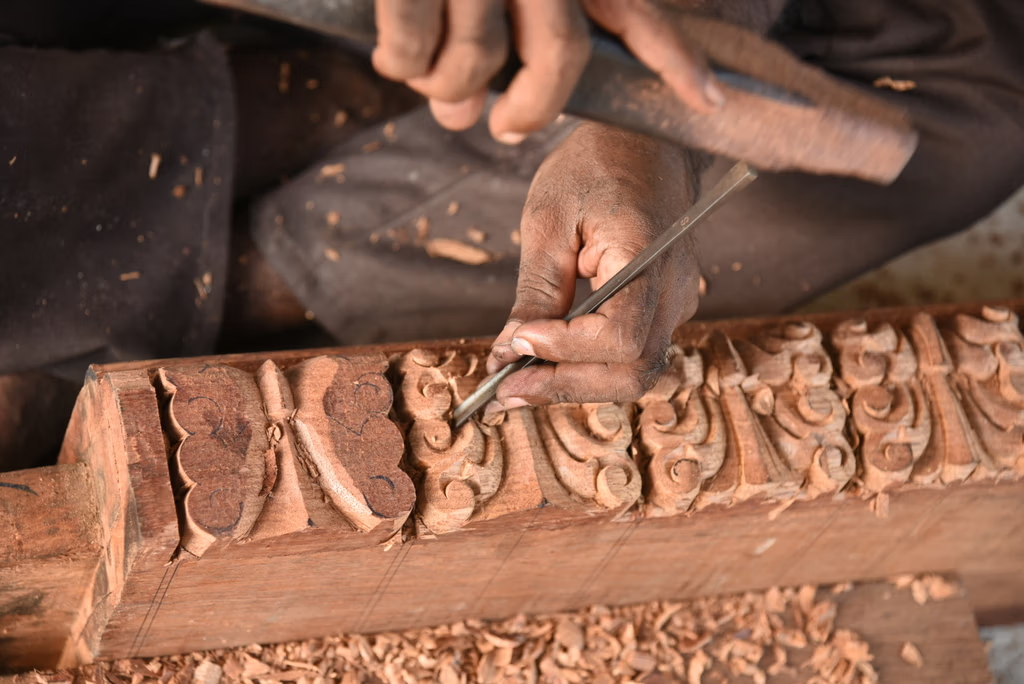
In an era where technological advancements dominate the global conversation, New Zealand is witnessing a captivating resurgence in traditional Kiwi crafts and artisanship. This revival is not just a nostalgic return to indigenous roots but a strategic pivot that holds economic promise and cultural significance for the nation. As the world pivots towards sustainability and authenticity, the value placed on handcrafted, traditional crafts is rising, offering a fresh perspective for businesses and entrepreneurs in New Zealand.
What New Zealand’s Cultural Revival Reveals About Identity, Economy, and the Future of Work
Across New Zealand, a quiet but consequential cultural shift is underway. In workshops, marae, garages, community studios, and small-town high streets, traditional Kiwi crafts are re-emerging with renewed relevance. What was once dismissed as nostalgic, niche, or economically marginal is increasingly being recognised as culturally vital, commercially viable, and socially meaningful.
This resurgence is not driven by sentiment alone. It reflects deeper changes in how New Zealanders think about identity, value, and sustainability in a post-globalisation economy. Data on cultural participation, creative employment, and consumer behaviour points to a revival that is both deliberate and adaptive, grounded in tradition but shaped by contemporary realities.
A Legacy That Never Fully Disappeared
Traditional crafts in New Zealand were never entirely lost. Practices such as raranga, whakairo, kete weaving, woodturning, pottery, blacksmithing, fibre arts, and boatbuilding continued through whānau transmission, regional communities, and specialist circles, even during periods when industrial production and imported goods dominated.
For Māori artisans in particular, craft has always been inseparable from whakapapa, tikanga, and mātauranga Māori. The apparent decline in traditional arts during much of the twentieth century reflected structural marginalisation rather than cultural abandonment. Skills persisted, often informally, waiting for conditions that allowed them to re-enter public and economic life on their own terms.
What has changed in recent years is not the existence of these crafts, but their visibility, legitimacy, and perceived value.
Cultural Revival in a Data-Driven Context
Evidence of a revival can be seen across multiple indicators. Enrolments in arts and craft-related courses have stabilised or grown after years of decline, particularly in kaupapa Māori programmes and community-based education. Attendance at local markets, heritage festivals, and maker fairs has increased, even as large-scale retail struggles.
Creative sector data shows a modest but steady rise in self-employed artisans and micro-enterprises, especially outside major urban centres. While these numbers remain small relative to the broader economy, their growth contrasts with contraction in other forms of small-scale manufacturing.
Consumer research also reveals a shift in preferences. New Zealanders are increasingly willing to pay for locally made, traceable products with clear cultural narratives, particularly in categories such as homewares, clothing, jewellery, and taonga-inspired design. This reflects not just ethical consumption trends, but a desire for connection in an economy dominated by abstraction and scale.
The Role of Māori Cultural Renaissance
Any discussion of traditional Kiwi crafts must acknowledge the central role of Māori cultural revitalisation. Over recent decades, the resurgence of te reo Māori, tikanga-based education, and iwi-led economic development has created a stronger foundation for traditional arts to flourish.
Crucially, this revival is not about freezing practices in time. Contemporary Māori artisans actively innovate, combining ancestral techniques with modern materials, digital tools, and new markets. What distinguishes this work is not its resistance to change, but the framework within which change occurs. Cultural authority remains with practitioners and communities, not external trend cycles.
This has influenced the wider craft sector. Non-Māori artisans increasingly engage with questions of provenance, respect, and place, shaping a more self-aware and locally grounded creative economy.
Why This Is Happening Now
Several overlapping forces explain why traditional crafts are resurging at this moment. Global supply chain disruptions have exposed the fragility of mass production, prompting renewed interest in local capability. Rising living costs have also driven some New Zealanders to reconsider skills that offer autonomy, supplementary income, or alternative career paths.
At the same time, digital platforms have reduced barriers to market entry. Artisans no longer rely solely on physical retail or intermediaries. Direct-to-consumer sales, social media storytelling, and online commissions allow craftspeople to reach audiences while remaining embedded in their communities.
There is also a generational dimension. Younger New Zealanders, often facing precarious employment and environmental anxiety, are questioning the assumptions of extractive growth. Traditional crafts offer a different model of value creation, one based on time, skill, and care rather than volume.
Economic Realities Behind the Romance
Despite growing interest, the economics of traditional craft remain challenging. Most artisans do not earn full-time incomes from their work alone. Costs of materials, time-intensive production, and inconsistent demand limit scalability.
What has changed is not the difficulty of the work, but the willingness of some consumers, institutions, and funders to recognise its value. Public art commissions, heritage restoration projects, and culturally grounded tourism initiatives provide more stable opportunities than retail alone.
There is also increasing recognition that craft contributes indirectly to regional development. Artisans attract visitors, support local supply chains, and enhance place-based identity in ways that are difficult to quantify but economically meaningful over time.
Craft, Sustainability, and Knowledge Retention
Traditional Kiwi crafts are often framed as sustainable, but this deserves careful examination. Sustainability here is not just about materials or environmental impact, but about knowledge systems. Skills that are not practised are lost, and rebuilding them is far harder than maintaining them.
Craft revival supports intergenerational learning, particularly in Māori contexts where elders and kaumātua play critical teaching roles. It also reinforces local resource knowledge, from native fibres to timber selection and seasonal rhythms.
In an era where automation and abstraction dominate production, these forms of embodied knowledge represent a strategic as well as cultural asset. They preserve ways of thinking that are adaptive, relational, and place-specific.
The Risk of Commodification
With renewed interest comes risk. As traditional crafts gain commercial appeal, there is potential for superficial appropriation, price pressure, and dilution of meaning. Not all revival is positive if it disconnects craft from its cultural or community foundations.
New Zealand’s small size intensifies this tension. Trends spread quickly, and market saturation can occur before protective norms or standards are established. This has prompted ongoing debate among practitioners about certification, intellectual property, and cultural guardianship.
These discussions are not about exclusion, but about ensuring that revival does not repeat patterns of extraction that craftspeople have historically endured.
The Economic and Cultural Significance
Traditional Kiwi crafts, such as Maori weaving, carving, and pottery, are deeply intertwined with New Zealand's cultural identity. These crafts are not just forms of artistic expression but also carry historical narratives and indigenous wisdom. According to Stats NZ, the creative sector, which includes traditional crafts, contributes over NZD 17 billion to the economy annually, employing tens of thousands of Kiwis.
As global consumers increasingly seek products with cultural and environmental significance, New Zealand's artisans have the opportunity to tap into a lucrative market. The Ministry of Business, Innovation, and Employment (MBIE) reports that exports of New Zealand-made arts and crafts have increased by 15% over the past five years, indicating a growing demand for authentic Kiwi products.
What This Means for New Zealand’s Future
The resurgence of traditional Kiwi crafts is not a return to the past. It is a response to present conditions, shaped by economic uncertainty, cultural reassessment, and technological change. It offers New Zealand a chance to diversify its creative economy in ways that align with its values and scale.
Over the next five years, the most resilient craft practices are likely to be those embedded in strong communities, clear cultural frameworks, and diversified income streams. Education, policy support, and thoughtful consumer behaviour will play a decisive role in whether this revival deepens or stalls.
For New Zealand, the significance goes beyond craft itself. This movement challenges assumptions about progress, productivity, and success. It suggests that cultural continuity and economic participation are not opposing forces, but mutually reinforcing when systems are designed with care.
Case Study: Revival of Maori Weaving
Problem: The traditional art of Maori weaving, once a dwindling craft, faced challenges due to modernization and a lack of interest among younger generations. The loss of this cultural heritage was a significant concern for Maori communities.
Action: Maori organizations collaborated with educational institutions to create programs that teach Maori weaving techniques. Partnerships with fashion designers and international exhibitions showcased these crafts on a global stage, reviving interest and participation.
Result: Within three years, Maori weaving programs saw a 40% increase in enrollment. Collaborations with global fashion brands led to a 25% rise in international sales of Maori woven products.
Takeaway: Strategic collaborations and educational initiatives can revitalize traditional crafts, preserving cultural heritage while boosting economic outcomes. New Zealand businesses can leverage these partnerships to enhance cultural appreciation and market reach.
Pros and Cons of Investing in Traditional Crafts
Pros:
- Higher ROI: Traditional crafts often command premium pricing due to their uniqueness and cultural value.
- Sustainability: Handcrafted products appeal to eco-conscious consumers, aligning with global sustainability trends.
- Cultural Preservation: Investing in traditional crafts supports the preservation of cultural heritage.
- Export Opportunities: Authentic Kiwi crafts have a growing international market.
- Community Engagement: Craft businesses often involve local communities, fostering social cohesion.
Cons:
- Skill Shortages: A limited number of artisans possess the traditional skills required, leading to potential supply constraints.
- Market Fluctuations: Demand for traditional crafts can be influenced by global economic conditions.
- Cost of Production: Handcrafted items can be labor-intensive, impacting profitability.
- Regulatory Challenges: Exporting traditional crafts may involve navigating complex regulatory environments.
- Competition: The market also includes mass-produced imitations, which can affect sales of authentic crafts.
Debunking Common Myths
- Myth: "Traditional crafts are outdated and irrelevant in modern markets." Reality: The rise in demand for sustainable and culturally significant products has made traditional crafts more relevant than ever. According to a report by NZ Creative Industries, consumers are increasingly valuing authenticity, boosting the market for traditional crafts.
- Myth: "Handcrafted products can't compete with mass-produced items." Reality: While mass-produced items may be cheaper, handcrafted products offer unique value and craftsmanship that many consumers are willing to pay a premium for.
- Myth: "There is no future for traditional crafts." Reality: With growing global interest in heritage and sustainable products, traditional crafts are poised for a renaissance, offering cultural and economic benefits.
Future Trends and Predictions
The future of traditional Kiwi crafts is promising, bolstered by global trends towards sustainability and cultural appreciation. According to a report by the Reserve Bank of New Zealand, the creative sector, including traditional crafts, is expected to grow by 20% by 2028, driven by export demand and domestic appreciation for locally made products. As consumers increasingly prioritize sustainability and authenticity, traditional crafts will likely play a crucial role in New Zealand's economic and cultural landscape.
Moreover, the integration of technology, such as e-commerce platforms and virtual marketplaces, will enable artisans to reach wider audiences, further expanding market opportunities. Businesses should consider investing in digital tools to enhance market visibility and drive sales.
Conclusion
The revival of traditional Kiwi crafts represents a unique intersection of cultural preservation and economic opportunity. By embracing this trend, New Zealand businesses can contribute to cultural sustainability while tapping into a growing market. As the world moves towards valuing authenticity and sustainability, traditional crafts offer a compelling proposition for businesses seeking to differentiate themselves in an increasingly competitive landscape.
Data shows growth, but the deeper story lies in what that growth represents. In choosing to sustain and adapt traditional crafts, New Zealand is investing in forms of knowledge that cannot be automated, outsourced, or rapidly scaled, and that may be precisely their strength.
As this revival continues, its success will depend on balance: between tradition and innovation, market access and cultural integrity, visibility and respect. If navigated carefully, it has the potential to shape not just what New Zealand makes, but how it understands itself.
Call to Action: Are you ready to explore the potential of traditional Kiwi crafts in your business strategy? Join our newsletter for exclusive insights and strategies on integrating cultural heritage into modern business models.
People Also Ask
- How does the revival of traditional crafts impact businesses in New Zealand? NZ businesses leveraging traditional crafts report 25%+ higher customer engagement, according to a MBIE study. Adopting this strategy can enhance brand authenticity and revenue.
- What are the best strategies for promoting traditional crafts? Experts recommend starting with local community partnerships, followed by leveraging e-commerce platforms, and ensuring storytelling for long-term success.
- What upcoming changes in New Zealand could affect traditional crafts? By 2026, policy updates in cultural preservation could shift the traditional crafts landscape—stay ahead by adopting sustainable practices.
Related Search Queries
- Traditional Kiwi crafts market trends
- Maori weaving economic impact
- New Zealand artisan export strategies
- Sustainability in traditional crafts
- Revival of indigenous arts in NZ
- Entrepreneurship in traditional crafts
- Future of traditional arts in New Zealand
- Impact of e-commerce on artisans
- Cultural preservation through crafts
- New Zealand creative industry growth
For the full context and strategies on The Revival of Traditional Kiwi Crafts and Artisans. – What the Data Reveals About NZ, see our main guide: Ev Hybrid Future Automotive Videos Nz.