



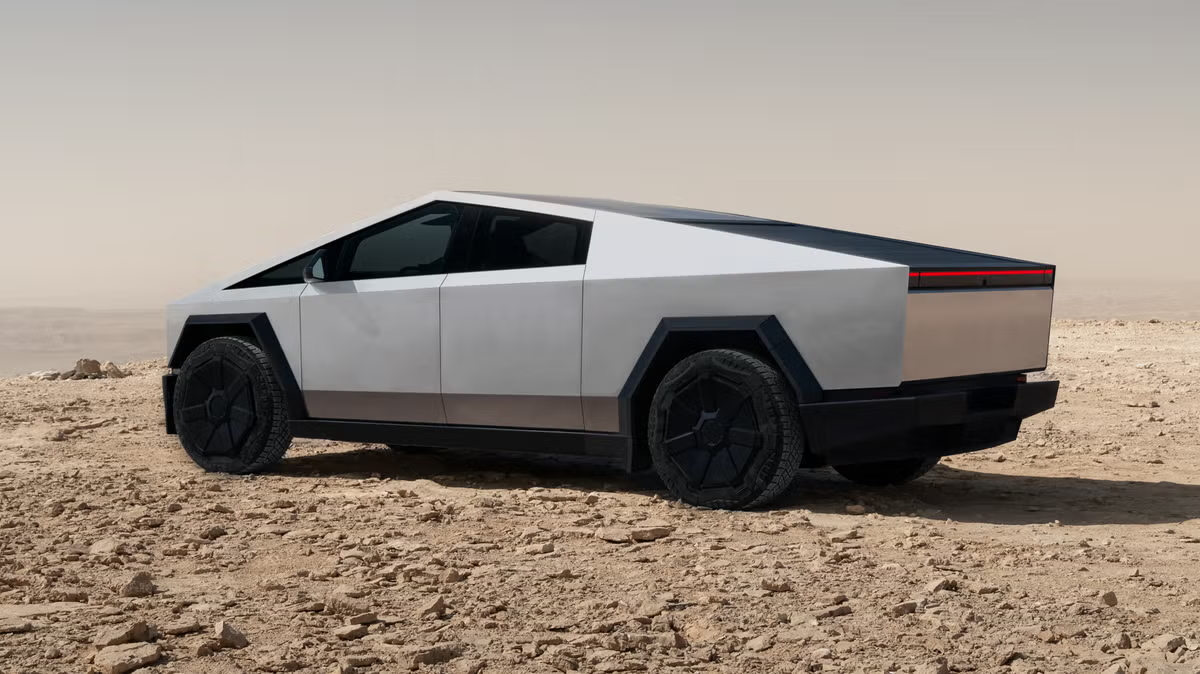
The recent, near-total recall of the Tesla Cybertruck by the National Highway Traffic Safety Administration (NHTSA) is not merely a story of a faulty accelerator pedal. For those of us who architect and deploy intelligent systems, it is a profound, real-time case study in the catastrophic failure of a specific AI paradigm: the over-reliance on end-to-end machine learning and sensor fusion without adequate layered safety engineering. This event exposes the dangerous chasm between Silicon Valley's "move fast and break things" ethos and the non-negotiable, physics-governed reality of safety-critical systems. In Australia, where our vast distances and unique driving conditions already test vehicle integrity to its limits, this recall serves as a critical warning. It underscores why our local regulatory bodies, like the ACCC and state-based transport authorities, must develop a sophisticated, AI-literate regulatory framework that goes beyond traditional compliance to interrogate the very architecture of autonomous and software-defined vehicles.
The Core Failure: A Systems Engineering Perspective
At its heart, the Cybertruck recall—triggered by a pedal cover that could dislodge and trap the accelerator—reveals a fundamental systems engineering breakdown. This is not a subtle software bug; it is a basic mechanical and design flaw that bypassed multiple supposed layers of quality control. From an AI and machine learning standpoint, this is emblematic of a broader, more insidious problem: the industry's tendency to treat advanced driver-assistance systems (ADAS) and autonomy as a software problem to be solved with data, while neglecting the deterministic, failsafe requirements of the physical hardware platform.
The vehicle's much-hyped "armoured glass" and exoskeleton design point to a prioritisation of form and perceived durability over functional, fault-tolerant engineering. When you build a platform intended to host increasingly autonomous software, that platform must be inherently safe. No amount of neural network training on vision or radar data can compensate for a pedal that physically jams. This is the equivalent of building a data centre on a foundation of sand and expecting flawless uptime because the servers have great cooling. The failure is systemic.
Where Most Brands Go Wrong: The AI-First Mirage
The automotive industry, led by Tesla, is making a costly strategic error by conflating data-driven innovation with robust systems engineering. The misconception is that collecting billions of real-world driving miles will inevitably solve safety. This is a dangerous oversimplification.
- Myth: More data equals safer autonomous systems.
- Reality: Data alone cannot account for edge cases in physical component failure, nor does it replace the need for formal verification methods. A neural network may learn to identify a pedestrian in rain, but it has no model for a pedal mechanism failing. These are separate safety domains that must be engineered in parallel, not assumed to be covered by a monolithic AI.
From consulting with local businesses across Australia in mining, logistics, and agriculture—sectors already deploying autonomous and remote-operated machinery—I see this pattern clearly. The most successful implementations are those that adopt a defence-in-depth approach. They combine sensor-based AI for perception with rigorously tested, redundant mechanical controls and human-in-the-loop oversight for critical functions. They don't assume the AI will handle everything.
Case Study: The Contrasting Path of Waymo vs. Tesla
To understand the alternative, one must look at companies like Waymo (a subsidiary of Alphabet). Their approach, while slower and more expensive, highlights the systems-thinking absent from Tesla's strategy.
Problem: Waymo needed to develop a fully autonomous vehicle (Level 4) that could operate safely in complex urban environments. The core challenge was ensuring safety wasn't just a statistical probability but a systemically engineered guarantee.
Action: Waymo did not retrofit a consumer vehicle. They engineered a purpose-built platform from the ground up. This included:
- Redundant Braking and Steering: Multiple independent systems to ensure vehicle control in case of a single component failure.
- LIDAR-Centric Sensor Suite: While using cameras and radar, they prioritised LIDAR for precise, 3D environmental mapping, creating a more deterministic model of the world than camera-only vision can provide.
- Simulation-First Validation: Before hitting public roads, billions of miles are driven in hyper-realistic simulation to test rare "corner case" scenarios, a process far more exhaustive than relying on fleet data accumulation.
- Geofencing: They initially limited operational domains (ODDs) to well-mapped areas, acknowledging the system's boundaries—a concept antithetical to Tesla's "Full Self-Driving" branding.
Result: Waymo's safety record in its operational areas is exemplary, with no at-fault fatalities and far lower incident rates than human drivers in comparable environments. Their approach has proven that a methodical, systems-engineering-led path to autonomy, while not generating the viral hype of Tesla's public beta tests, produces a fundamentally safer and more reliable product.
Takeaway for Australia: For Australian companies developing autonomous systems for ports, mines, or farms, the lesson is profound. Drawing on my experience in the Australian market, a mining company retrofitting autonomy onto a 200-ton haul truck cannot afford a Tesla-style approach. The platform's mechanical and control systems must be engineered for failsafe operation first; the AI is a layer that enhances efficiency, not the sole guarantor of safety. The ACCC and Safe Work Australia regulations will, and should, demand this level of systemic assurance.
The Australian Context: A Regulatory Imperative
Australia presents a unique and harsh proving ground. Corrugated dirt roads, extreme temperatures, dust, and wildlife create a sensor-fusion nightmare that no amount of training data from California highways can solve. Our regulatory environment must evolve to meet this challenge.
Currently, vehicle recalls in Australia are managed under the Australian Consumer Law enforced by the ACCC, with safety standards largely harmonised with UN/ECE regulations. However, these frameworks are reactive and based on traditional mechanical compliance. The Cybertruck situation reveals the urgent need for a proactive, AI-aware regulatory posture.
The Australian government should look to the EU's proposed AI Act, which classifies AI in critical infrastructure as "high-risk" and mandates rigorous risk management, data governance, and human oversight. Applying this lens, a vehicle's autonomous driving system would require:
- Architecture Transparency: Disclosure of sensor fusion strategies, failure mode analyses, and the boundaries of the AI's operational design domain.
- Australian-Condition Validation: Mandated testing in simulated and real Australian conditions before approval, not just post-market surveillance.
- Data Sovereignty & Incident Reporting: Clear protocols for storing and analysing incident data locally, ensuring the ACCC and Department of Infrastructure can access unfiltered data to understand failures.
Based on my work with Australian SMEs in the tech sector, there is both a fear and an opportunity here. The fear is of cumbersome, innovation-stifling regulation. The opportunity is for Australia to become a global leader in certifying safe autonomous systems for harsh environments, creating an exportable regulatory technology (RegTech) and testing industry. The Australian Bureau of Statistics reports over 20 million registered vehicles in the country. The safety and economic impact of getting this transition wrong is incalculable.
Pros & Cons: The Two Paths to Autonomous Driving
✅ The Tesla "AI-Centric, Fleet-Learning" Approach
- Rapid Iteration: Software updates can be deployed over-the-air to millions of vehicles simultaneously, allowing for quick fixes and feature rollouts.
- Unprecedented Data Scale: Accesses a massive, real-world dataset from its global fleet, potentially capturing rare long-tail events.
- Consumer-Facing Innovation: Creates a compelling, evolving product that drives brand loyalty and market valuation.
- Lower Upfront Sensor Cost: Relies heavily on cameras, which are cheaper than LIDAR, aiming for an economically scalable solution.
❌ The Waymo "Systems-First, Geofenced" Approach
- Extremely High Development Cost: Custom vehicles, expensive sensor suites (LIDAR), and massive simulation infrastructure require colossal capital.
- Slow, Deliberate Scaling: Expansion to new cities is methodical and slow, limiting short-term commercial reach.
- Limited Real-World Data Diversity: Initially confined to geofenced areas, though simulation compensates for this.
- Consumer Inaccessibility: Deployed as a robotaxi service, not a personal vehicle product, limiting its direct market appeal.
The Middle Ground: The optimal path likely lies in a hybrid. Use the systems-engineering rigor of the Waymo approach for safety-critical vehicle control (steering, braking, acceleration) and fault detection. Augment this with fleet-learning AI for improving perception models and handling complex, non-safety-critical decision-making within a well-defined and verified safe envelope. This is the direction forward-thinking Australian automotive tech companies should invest in.
Future Trends & Predictions: The Reckoning for Software-Defined Vehicles
The Cybertruck recall is a harbinger, not an anomaly. As vehicles become "computers on wheels," the attack surface for failures—both mechanical and digital—expands exponentially. My predictions for the next five years:
- Regulatory Fracture: We will see a divergence between markets. The EU and potentially Australia will enforce strict, architecture-based AI safety regulations. The US may remain more fragmented, leading to a bifurcated global market.
- The Rise of "Safety Case" Certification: Merely passing a test will be insufficient. Manufacturers will be required to submit a comprehensive "safety case" to regulators like the ACCC, proving through simulation, formal methods, and real-world testing that their AI-driven systems are safe under defined conditions.
- Cyber-Physical Insurance Models: In Australia, insurance premiums will become directly tied to a vehicle's software stack and its proven safety record. Insurers will demand access to telemetry data to assess the risk profile of a car's AI, not just its driver.
- Australian Niche Leadership: Australia will develop world-leading testing facilities for autonomous systems in extreme conditions (dust, flood, off-road). Companies like Baraja (with its unique Spectrum-Scan LiDAR) are already pointing the way, creating hardware suited to our environment.
Final Takeaway & Call to Action
The Cybertruck recall is a $2 billion lesson in the perils of prioritizing disruption over diligence. For the AI and machine learning community in Australia, it is a clear signal: our expertise must expand beyond optimizing neural networks. We must become fluent in systems engineering, formal verification, and the development of robust AI that knows its limits.
Action for Australian Tech Leaders & Policymakers:
- For Founders: If you're building in robotics, AVs, or industrial AI, hire systems engineers as your first technical hires. Design failsafes and redundancy into your physical platform from day one.
- For Investors: Scrutinize the safety architecture of your portfolio companies. A slick AI demo is not a product. Demand to see their Failure Mode and Effects Analysis (FMEA) for both hardware and software.
- For Regulators (ACCC, Dept of Infrastructure): Convene an expert task force on AI and vehicle safety now. Develop draft standards that mandate transparency, Australian-condition testing, and a safety-case framework before these vehicles arrive en masse.
The race to autonomy is not a sprint; it's a marathon of relentless, meticulous engineering. The companies and nations that understand this will build the future. The others will be remembered for their recalls.
What's your take? Does Australia need to lead with stricter AI safety regulation, or would that stifle a critical industry? Share your insights below.
People Also Ask (PAA)
How does the Tesla recall impact the adoption of electric vehicles in Australia? The recall damages consumer confidence in flagship EV innovation, potentially slowing adoption. However, the core issue is specific to Tesla's design philosophy, not EV technology itself. It may accelerate scrutiny of all software-defined vehicles, regardless of powertrain.
What are the biggest misconceptions about self-driving car safety? The biggest misconception is that "self-driving" AI is a general intelligence that can handle any situation. In reality, even advanced systems are narrow AI with strict operational limits. Safety depends on clearly defining those limits and engineering the vehicle to remain safe when they are exceeded.
What should Australian consumers look for when considering a car with advanced driver-assist features? Look beyond marketing terms like "Autopilot." Research the vehicle's safety ratings from ANCAP, specifically for its vulnerable road user protection and safety assist technologies. Prefer systems that use a combination of camera, radar, and possibly LiDAR for redundancy, and understand if the manufacturer clearly communicates the system's limitations.
Related Search Queries
- Tesla Cybertruck accelerator pedal recall Australia
- AI safety regulations for self-driving cars Australia
- Waymo vs Tesla autonomous driving technology difference
- ACCC vehicle recall policy software defects
- Future of autonomous vehicles in Australian mining
- How does LiDAR improve self-driving car safety
- Australian standards for autonomous vehicle testing
- Cost of Tesla Cybertruck recall for shareholders
- Systems engineering vs machine learning for robotics
- Best practices for AI in safety-critical applications
For the full context and strategies on Safety regulators recall almost all Tesla Cybertrucks – How Aussie Leaders Are Responding, see our main guide: Saas App Demo Videos Australia.