




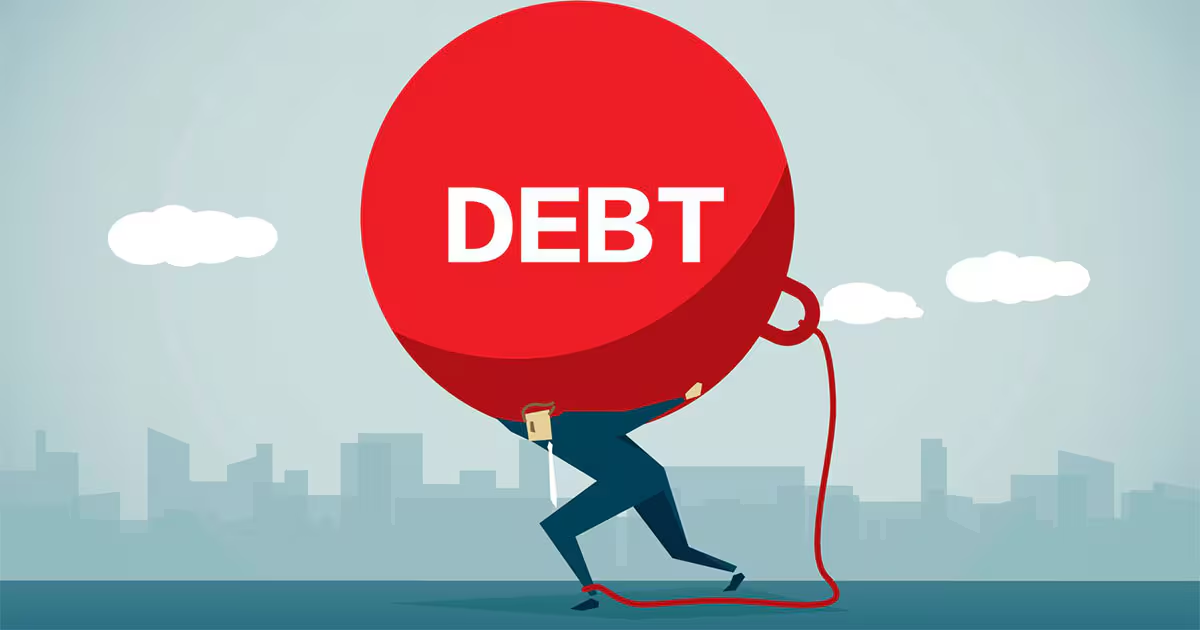
The Australian financial landscape is often painted as a bastion of stability, a 'four pillars' fortress protecting consumers from the worst excesses seen elsewhere. This is a comforting narrative, but one that dangerously obscures a more insidious reality. Beneath the surface of everyday banking—the friendly local branch, the slick mobile app—lies a sophisticated, data-driven architecture explicitly designed to maximise customer indebtedness. Profit in modern retail banking is not merely a byproduct of providing services; it is an engineered outcome, a direct result of strategies that quietly encourage, normalise, and perpetuate debt. For the financially savvy, understanding these mechanisms is not academic; it is an essential act of defence.
The Core Engine: How Interest Income Drives Everything
To comprehend the tactics, one must first understand the engine. For Australia's major banks, net interest income—the difference between what they earn on loans and pay on deposits—remains the profit cornerstone. The Reserve Bank of Australia (RBA) data consistently shows that household interest expenses as a share of disposable income have surged with rising rates, directly boosting bank margins. When the RBA lifts the cash rate, banks are often quicker to pass increases onto mortgage holders and credit card users than to savers. This asymmetry is not an accident; it's a business model. Every percentage point of interest paid on a credit card balance, every year added to a mortgage term, and every personal loan taken for a lifestyle purchase feeds this engine. The entire system has a vested interest in ensuring you, the customer, remain a reliable, long-term interest payer.
Architecting Dependence: The Strategic Use of Credit Limits
One of the most psychologically potent tools is the unsolicited credit limit increase. Based on my work with Australian SMEs on their corporate cards and facility management, I've seen the internal logic. Banks deploy complex behavioural scoring models that assess not just your ability to repay, but your likelihood of utilising increased credit. Receiving a letter stating "Your limit has been increased to $25,000 as a valued customer" is framed as a reward, a token of trust. In reality, it's a calculated risk expansion. The data shows that a significant portion of customers will, over time, 'grow into' these limits. This normalises higher levels of revolving debt, transforming a potential safety net into a persistent financial burden. The action for Australians is simple and immediate: log into your banking app and reject automatic limit increases. Set your limit to a level you can comfortably pay off each month, and treat it as a fixed parameter, not a growing privilege.
Reality Check for Australian Businesses and Consumers
Several pervasive myths allow these banking strategies to flourish unchecked. Challenging them is the first step toward financial autonomy.
Myth 1: "My bank has my best financial interests at heart." Reality: A bank's fiduciary duty is to its shareholders, not its customers. Their product design, sales targets, and incentive structures are aligned with profit maximisation, which often conflicts with optimal customer outcomes. The Banking Executive Accountability Regime (BEAR) and the Royal Commission aftermath improved conduct, but did not alter this fundamental profit motive.
Myth 2: "Minimum payments are a sensible way to manage credit card debt." Reality: Minimum payments are a debt trap, meticulously calculated to extend the repayment period for as long as possible. ASIC analysis has previously shown that making only the minimum payment on a $3,000 credit card debt could take over 15 years to clear, incurring thousands in interest. It is a designed feature to maximise interest revenue.
Myth 3: "Debt consolidation loans simplify and save you money." Reality: While they can lower monthly outgoings, they often achieve this by dramatically extending the debt's lifespan. Rolling short-term, high-interest credit card debt into a long-term secured loan can mean paying more interest over the full life of the loan. It also risks turning unsecured debt into debt secured against your home.
The "Solution" Bait: Debt Products as a Cure for Debt
Perhaps the most sophisticated trick is positioning new debt as the solution to existing debt. Balance transfer credit cards with long 0% interest periods are a prime example. The allure is undeniable: move existing debt to a new card and pay no interest for 24 months. However, from observing trends across Australian businesses and consumers, the failure rate is high. The traps are multiple: hefty balance transfer fees (often 1-2%), reversion to exorbitant standard rates after the promo period, and the critical fact that new purchases often do not qualify for the 0% rate and accrue interest immediately. The bank's calculus is that a substantial subset of customers will fail to clear the balance in time, will use the card for new spending, or will simply transfer the debt again, entering a perpetual cycle. The product is not designed for debt elimination; it's designed for debt migration and eventual recapture.
Case Study: The Afterpay Phenomenon and the Mainstreaming of Micro-Debt
Problem: Traditional credit cards faced growing consumer distrust and regulatory scrutiny post-Royal Commission. A gap emerged for a modern, seemingly less harmful form of credit, particularly among younger demographics wary of revolving debt. The challenge was to make debt frictionless and socially acceptable.
Action: Afterpay and other Buy Now, Pay Later (BNPL) providers exploded onto the scene by decoupling credit from the traditional banking lexicon. They offered instant, interest-free, short-term instalment plans at checkout, framed as a budgeting tool rather than a loan. Merchants bore the cost via fees, making it feel 'free' to consumers. The psychological barrier to spending was dramatically lowered.
Result: BNPL use in Australia became ubiquitous. According to ASIC, as of 2022, over 7 million Australians had used a BNPL service. Critically, ASIC's research also found that 15% of BNPL users had missed a payment on another bill to meet a BNPL repayment, and 20% had cut back on essentials. The model's profitability relies on merchant fees and late payment charges from a minority of users who struggle with the schedule. It has successfully mainstreamed micro-debt, creating a gateway to financial stress and priming users for traditional credit products later.
Takeaway: The BNPL model is a masterclass in debt rebranding. For Australians, the action point is to treat BNPL not as free money, but as a series of binding future commitments. Use it only if you can pay the first instalment upfront and have the cash flow to cover all subsequent payments without fail. Better yet, use a debit card.
Data, Personalisation, and Predictive Entrapment
In my experience supporting Australian companies in open banking and data analytics, the depth of transactional data a bank holds is its most powerful asset. Every transaction is a behavioural signal. Algorithms now predict life events—a change in job, a pregnancy, a holiday—and time marketing for loans or credit increases accordingly. This 'predictive entrapment' targets consumers at moments of financial flux or perceived opportunity. Seeing a pre-approved personal loan offer days after searching for holiday packages is not a coincidence; it's a calculated intervention based on your data. The upcoming Consumer Data Right (CDR) expansion presents both a risk and an opportunity: while it allows you to share your data for better deals, it also further fuels this hyper-personalised debt-marketing machine.
The Regulatory Landscape: Well-Intentioned, But Outpaced
Australian regulators like APRA and ASIC have taken steps. APRA's macroprudential measures have targeted investor and interest-only lending. ASIC's product intervention powers have been used on some sectors. However, regulation is inherently reactive and slow-moving. It focuses on preventing egregious harm and systemic risk, not on dismantling the fundamental profit-from-debt model. Responsible lending obligations were diluted post-Royal Commission, and the innovation in financial products (like BNPL) consistently runs ahead of the regulatory framework. The onus, therefore, remains disproportionately on the consumer to navigate this engineered landscape.
Future Trends & Predictions: The Next Frontier of Indebtedness
The architecture of debt is evolving, not receding. We are moving towards even greater embeddedness and behavioural integration.
- Embedded Finance & Debt-as-a-Service: Debt offerings will become seamlessly integrated into non-financial platforms—a car loan at the dealership's website, a retail loan at an online furniture store, a 'travel now, pay later' option directly within a booking app. The friction of applying for credit will vanish, making it the path of least resistance.
- AI-Powered Hyper-Personalisation: Using Open Banking and CDR data, AI will not just predict but actively shape financial behaviour. Imagine your banking app nudging you towards a loan for a project it infers you want, based on your spending patterns and social media activity (with consent murkily obtained).
- Wearable Finance & Emotional Spending Triggers: As finance integrates with wearables and health data, lenders could one day assess risk or target offers based on stress levels or location data. A lender might identify a consumer leaving a gym (feeling positive) and offer a 'reward' loan or increased limit.
Drawing on my experience in the Australian market, the counter-strategy must be one of conscious disengagement. This means actively using technology to block these engineered pathways: turning off overspending alerts that normalise debt, using apps that round up savings instead of spending, and choosing 'debt-free' digital banking experiences that are beginning to emerge.
Final Takeaway & Call to Action
The secret is out: the modern Australian banking system is not a neutral utility. It is a finely tuned machine that profits from sustained, manageable consumer debt. The tricks—from behavioural credit limits and minimum payment traps to the rebranding of debt via BNPL—are all features of this design. Your financial health is not their KPI; your reliable interest payments are.
Your defence is both tactical and philosophical. Tactically: freeze your credit limits, auto-pay credit cards in full, reject debt consolidation that extends terms, and treat BNPL as a scheduled cash expense. Philosophically: shift your mindset from being a 'borrower' to being an 'owner'. Seek financial products that align with asset building and liquidity, not liability management.
The most powerful move you can make is to vote with your wallet. Support fintechs and neobanks whose models are based on subscription fees for services, not interest income from your debt. Demand transparency. The future of Australian finance doesn't have to be a debt trap; it can be a platform for genuine prosperity, but only if we, as informed consumers and professionals, force that change.
What's your most effective strategy for avoiding engineered debt? Share your insights and challenge the status quo in the comments below.
People Also Ask (PAA)
Are Australian banks allowed to trick customers into debt? While outright deception is illegal, banks are permitted to design products and marketing strategies that encourage debt uptake, as it's core to their profit model. Regulations like responsible lending aim to prevent unsuitable loans, but many persuasive tactics operate in a legal grey area of behavioural influence.
What is the most profitable type of debt for Australian banks? Credit card debt is typically the most profitable per dollar lent due to its high interest rates (often 18-22% p.a.) and revolving nature. However, home loans represent the largest volume of interest-earning assets, making them the overall earnings cornerstone.
How can I tell if a financial product is designed to keep me in debt? Key red flags include: emphasis on minimum payments, unsolicited credit limit increases, long low-interest periods that revert to very high rates, and consolidation loans that dramatically lower your monthly payment by extending the term for many extra years.
Related Search Queries
- bank tricks to keep you in debt Australia
- how do banks make money from credit cards
- ASIC credit card debt statistics
- buy now pay later debt trap Australia
- how to avoid bank fees and interest Australia
- best debt reduction strategy Australia 2024
- ethical banks Australia no debt promotion
- RBA household debt data Australia
- consumer data right and lending Australia
- psychology of credit card spending
For the full context and strategies on The Secret Tricks Banks Use to Keep Australians in Debt – The Rise of This Trend Across Australia, see our main guide: Vidude For Creators.